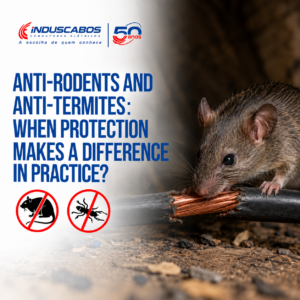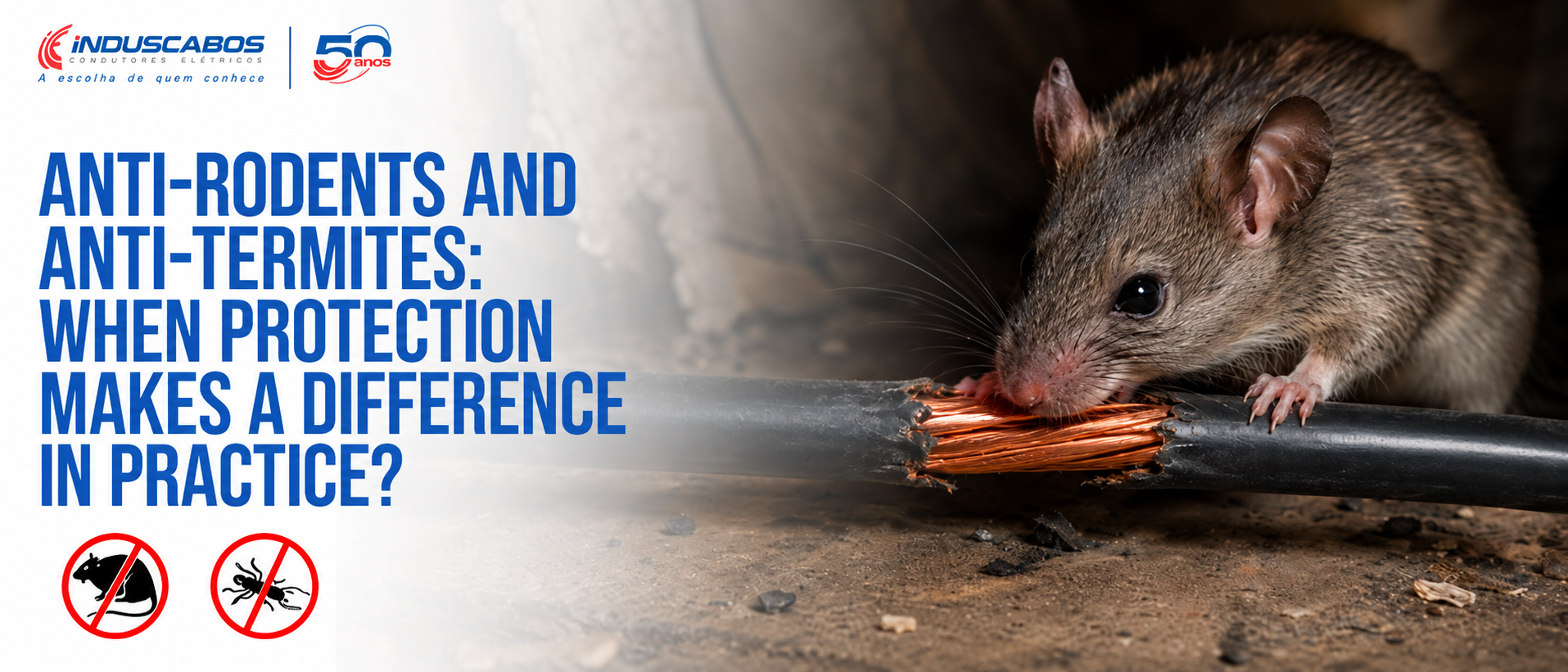
Rodent- and termite-resistant cable is a topic that deserves attention whenever an electrical installation is exposed to environmental conditions that can compromise its integrity over time. In industrial, rural, and underground projects, the environment is not just a construction detail: it directly influences cable durability, maintenance frequency, and the risk of failures.
When discussing protection against rodents and protection against termites, the key point is not to sell a universal solution, but to assess whether the cable needs an additional layer of protection based on the actual installation scenario. In many cases, the problem begins subtly, with external damage to the jacket, and can evolve into more complex interventions in the electrical system.
Therefore, cable specification should consider not only current, voltage, and installation method, but also the site’s history, the presence of pests, proximity to the ground, and exposure to galleries, tunnels, and hard-to-access areas. This technical assessment of the environment helps determine when rodent-resistant and termite-resistant cables make a practical difference.
What does rodent- and termite-resistant protection mean in a cable?
Rodent- and termite-resistant characteristics indicate that the cable was designed to reduce vulnerability to external pest attacks that can affect its jacket, insulation, and, in some cases, other layers of the cable construction. This is not absolute protection, nor is it a solution that replaces good installation, inspection, and environmental control practices. It is an additional electrical cable protection feature for scenarios where the risk is relevant.
It is important to distinguish between the two risks. Rodents can cause damage by biting, tearing, or puncturing the outer jacket and exposing internal layers. Termites act differently: they can attack susceptible materials present in the installation and, depending on the context, contribute to the degradation of components and pathways where the cable is installed. In both cases, the practical impact is similar: the integrity of the system is compromised.
In industrial practice, interest in rodent-resistant and termite-resistant cables arises when the environment has a history of pests, recurring animal presence, or conditions that favor this type of occurrence. In these scenarios, choosing the right cable helps reduce damage to electrical cables and preserve operational continuity.
Why the environment must be considered in the specification
A cable may be correctly sized from an electrical standpoint and still be unsuitable for the installation location. This happens because service life depends not only on electrical performance, but also on exposure to external agents. When the specification ignores the environment, the installation becomes more prone to unexpected interventions, downtime, and premature replacements.
How external damage progresses within the installation
Damage to electrical cables does not always begin with a visible electrical failure. Often, the first sign appears on the outer jacket, which may be bitten, punctured, worn, or compromised by biological agents. When this barrier is affected, the cable loses part of its physical protection and becomes more exposed to moisture, dirt, abrasion, and other environmental factors.
This process matters because the outer jacket is not merely a finishing layer. It acts as a protective barrier that helps preserve the cable structure during use. If this layer is damaged, the integrity of the assembly can be affected even before an immediate failure occurs. In critical installations, this means a greater risk of corrective maintenance and greater difficulty in locating the source of the problem.
In some cases, the problem progresses silently. The cable continues operating for a period, but with reduced protection. Over time, exposure can reach more internal layers and increase the likelihood of interruptions, localized heating, loss of reliability, and the need for replacement. For this reason, protection against rodents and protection against termites should be viewed as part of a broader cable durability strategy.
- First, the outer jacket is attacked
- Then the cable’s physical protection is reduced
- Next, the risks of exposure and failures increase
- Finally, unplanned maintenance and premature replacements may occur
In which applications can rodent-resistant and termite-resistant cables be relevant?
Not every project requires this type of protection. The decision should be made on a case-by-case basis, according to the application, environment, and installation conditions. Even so, there are scenarios in which the use of rodent-resistant or termite-resistant cables may be especially appropriate, precisely because the risk of external attack is more likely or more difficult to control.
Common contexts include industrial areas with pest presence, rural installations, locations close to the ground, technical galleries, tunnels, underground infrastructure, and routes where visual inspection is limited. Environments with a history of previous incidents should also be considered, since repeated problems often indicate the need to review the cable specification.
On construction sites and in plants with many buried sections, concealed pathways, or hard-to-access points, any external damage tends to be more difficult to identify. In these cases, electrical cable protection becomes more important because it helps reduce the risk of corrective interventions and unplanned downtime. For distributors, resellers, designers, and technical buyers, this is a criterion that can directly influence the choice of the most suitable product for each application.
Examples of situations where evaluation is recommended
The assessment is usually more relevant when the cable is exposed to conditions that favor contact with pests or when subsequent maintenance is difficult. This includes underground passages, outdoor areas with nearby vegetation, installations in soil, low-accessibility structures, and industrial environments with a history of recurring damage.
How to assess whether the protection makes sense for the project
The need for rodent-resistant and termite-resistant cables should be assessed based on technical criteria, not as a general rule. The first step is to understand the installation environment. The second is to assess the criticality of the application. The third is to consider the operational cost of a potential failure, including process downtime, access to the damaged section, and replacement time.
It is also important to analyze whether the site already has pest-control measures, whether periodic inspections are performed, and whether the installation was designed to facilitate maintenance. When these factors are limited, specifying a cable with additional protection can contribute to greater reliability. When the environment is controlled and the risk is low, this feature may not be necessary.
This reasoning is especially useful in B2B projects, where the purchasing decision must balance performance, actual application, and total cost of ownership. Instead of looking only at the cable itself, it is worth considering the whole system: environment, installation method, future access, and expected service life. This is where Induscabos acts as a technical partner, supporting cable selection according to the requirements of each project.
- Map the environment and the history of pests
- Check the criticality of the electrical installation
- Assess the ease of inspection and maintenance
- Determine whether the additional protection adds value to the project
Additional protection does not replace good installation practices
Even when the cable has rodent-resistant or termite-resistant characteristics, this does not eliminate the need for pest control, proper installation, inspections, and periodic maintenance. Cable protection is only one part of the reliability strategy. If the environment continues to favor pest attacks, the risk does not disappear completely.
For this reason, the most effective approach combines correct specification, proper execution, and ongoing system monitoring. In industrial installations and harsh environments, this integrated view helps preserve cable durability and reduce failures caused by external damage. It also helps prevent emergency replacements, which are usually more expensive and more difficult to plan.
Another important point is not to confuse these characteristics with flame-retardant protection, fire resistance, or generic mechanical resistance. Each attribute addresses a specific need. When the project requires protection against rodents or termites, the focus should remain on that risk, without mixing functions that are not equivalent.
What the specifier should consider
Before defining the cable, it is worth reviewing the site’s history, the type of installation, and the exposure along the route. This assessment helps prevent unsuitable choices and aligns the product with field conditions. In many projects, this simple step makes a difference in the long-term reliability of the electrical system.
Conclusion: specifying according to the environment reduces operational risks
Rodent- and termite-resistant cable makes a difference when the environment actually exposes the installation to risks of biting, termite attack, or pest-related degradation. In these cases, the additional protection can contribute to greater durability, better field performance, and a reduced need for unexpected interventions. However, it should be treated as a technical feature within a broader project, not as a universal solution.
By considering the actual installation conditions, the designer or technical buyer improves the quality of the specification and reduces the chance of selecting a cable that is unsuitable for the context. This decision is even more important in industrial, rural, and underground areas, as well as in locations with a history of incidents. In all these scenarios, environmental analysis is an essential part of the engineering applied to cable selection.
For Induscabos, cable selection must match the requirements of each application, with a focus on safety, reliability, and technical suitability. When the project calls for additional protection against rodents or termites, the solution should be evaluated carefully and with a long-term perspective.
Request guidance to specify the right cable for your environment
If your project requires special attention to protection against rodents, protection against termites, or the selection of cables for harsh environments, the correct specification can reduce the risk of failures, rework, and unexpected maintenance. Induscabos serves the technical demands of the B2B market and can support the selection of the most suitable cable for each application.
Request a quote with technical guidance for rodent-resistant and termite-resistant cables