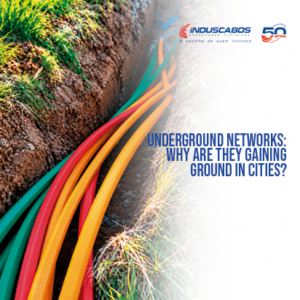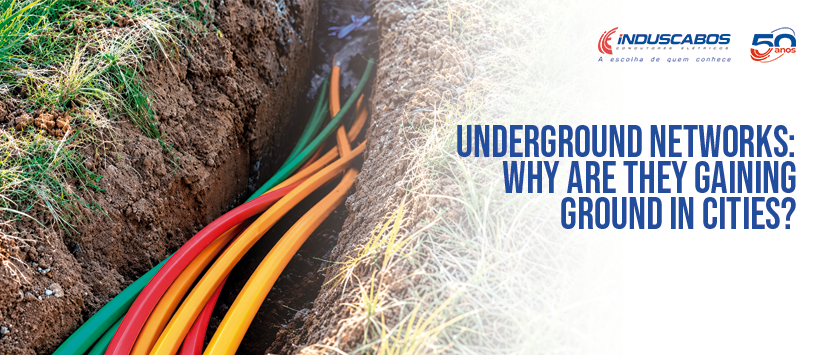
Underground electrical networks are gaining ground in urban projects that seek greater organization, protection, and predictability in power distribution. Instead of routing cables along poles and exposed structures, this approach places the infrastructure in utility tunnels, ducts, or utility trenches, reducing direct exposure to adverse weather and interference from the urban environment.
In practice, this approach meets the demands of urban modernization, especially in areas with heavy pedestrian traffic, high building density, and a need to preserve the cityscape. It also facilitates integration with other urban electrical infrastructure systems, provided the design properly accounts for the cable type, installation method, and operating conditions.
For technical and B2B audiences, understanding how underground networks operate is essential for specifying materials with greater confidence. The choice of cables for underground networks directly affects power distribution reliability, ease of maintenance, and long-term system performance.
What are underground electrical networks and how do they work?
Underground electrical networks are distribution systems in which conductors are installed below ground level, protected by ducts, conduits, cable channels, or dedicated utility tunnels. They can be used at different levels of the network, depending on the design, expected load, and distribution strategy adopted for the utility network, development, or industrial facility.
They operate according to the same principles as any power distribution system: electricity flows through cables sized for the application, passes through protection and switching devices, and reaches consumers within the parameters defined in the design. The difference lies in the installation environment, which requires special attention to insulation, heat dissipation, mechanical protection, and resistance to moisture and other external factors.
In urban centers, this approach is often adopted when infrastructure needs to be reorganized, visual clutter reduced, or the physical protection of circuits increased. It is therefore frequently used in electrical network modernization projects, downtown revitalization, new subdivisions, and developments with higher reliability requirements.
- Below-ground installation with additional physical protection
- Use of cables suited to the environment and thermal requirements
- Integration with ducts, pull boxes, and access points
- Use in urban, industrial, and power distribution projects
Why cities are adopting this infrastructure
The adoption of underground electrical networks is not driven by a single factor. It addresses a range of urban needs that have become more evident with increasing urban density, the expansion of essential services, and the demand for more organized and functional environments. In many cases, the decision involves urban planning, electrical safety, and the enhancement of public spaces.
One of the main drivers is reduced exposure of the network to weather events and external impacts. Strong winds, falling trees, collisions with utility poles, and other factors affecting overhead lines tend to have less impact when cables are protected underground. This does not eliminate failures or outages, but it can reduce vulnerability to certain external events.
Another important factor is a more orderly cityscape. In downtown areas, commercial corridors, tourist districts, and upscale developments, removing cables and poles from the landscape helps create a cleaner, more functional urban environment. In addition, underground infrastructure can make it easier to plan sidewalks, roadways, access routes, and other urban improvements.
There is also a technical reason related to protection against external interference. Because the cables are less exposed, the system tends to be less affected by accidental contact, vandalism, and direct mechanical interference. This is especially important in busy locations or where multiple infrastructure systems share the same space.
Advantages and limitations compared with overhead networks
When comparing overhead and underground networks, it is important to avoid an oversimplified view. Each solution is better suited to certain circumstances, and the choice must account for cost, maintenance, available space, load criticality, and urban planning. Even so, underground networks offer clear advantages where protection and urban integration are priorities.
Among the most commonly cited benefits are reduced exposure to adverse weather, less visual clutter, and additional protection against external damage. However, installation generally requires a higher initial investment, more complex civil works, and more detailed planning for future access, inspection, and maintenance.
In overhead networks, visual inspection is usually easier and work at certain points can be more straightforward. In underground networks, access to installed sections depends on pull boxes, manholes, or other access structures included in the design. This highlights the need for a well-developed network layout from the outset, with clearly defined routes, access points, and maintenance criteria.
- Less exposure to wind, heavy rain, and falling objects
- Better integration with urban electrical infrastructure projects
- Less visual impact in densely developed areas
- Greater planning requirements for installation and maintenance
- Generally higher initial investment than for overhead networks
Challenges in installation, maintenance, and initial investment
Installing underground electrical networks involves challenges that must be considered from the design stage. The first is the civil works, which may require excavation, trenching, duct installation, and coordination with other infrastructure systems already in place. In established urban areas, this may take more time and require closer control of construction activities.
Maintenance is another important consideration. Although the network is better protected, locating and accessing faults may require more complex procedures. Therefore, the design should include inspection points, clearly organized network sections, and appropriate technical documentation to facilitate future work without compromising system operation.
Initial investment is also often a deciding factor. The cost of underground installation is higher than that of an overhead solution, mainly because of civil works and additional components. Even so, the analysis should not be limited to installation costs. It is necessary to assess the infrastructure life cycle, the criticality of the application, and the impact of the solution on the urban environment and electrical operations.
For industrial, commercial, and public developments, the right decision depends on balancing performance, electrical safety, ease of expansion, and planned maintenance. When properly specified, an underground network can contribute to more stable operation aligned with the site’s requirements.
Key aspects to consider during planning
Before construction begins, it is important to consider conflicts with existing networks, soil conditions, drainage needs, maintenance accessibility, and compatibility with the rest of the electrical infrastructure. These factors influence both system performance and durability.
The importance of proper cable specification
In underground electrical networks, cable selection cannot be treated as a secondary step. The cable must be suitable for the installation environment and actual operating conditions, taking into account insulation, moisture, temperature, mechanical stress, and the installation method. An unsuitable cable specification can compromise system reliability and increase the need for corrective work.
Insulation is one of the most important factors because the cable will be exposed to conditions different from those found in overhead installations. Moisture, temperature variations, and contact with surrounding materials require careful attention to long-term cable performance. In addition, the design must consider heat dissipation, as current-carrying capacity can be affected by installation conditions.
It is also important to consider the type of application. In many cases, underground power distribution involves medium-voltage cables, but selection depends on voltage level, load, installation method, and project requirements. The same applies to industrial electrical cables used in other sections of the infrastructure, which must maintain stable performance in more demanding environments.
To specify cables correctly, engineers, designers, and technical buyers must assess not only the cable itself but also the system as a whole: ducts, accessories, bending radius, pull points, and maintenance conditions. This integrated approach reduces risks and supports a more reliable installation.
- Suitability for moisture exposure and soil conditions
- Suitability for operating temperature and installation method
- Mechanical strength suitable for underground cable laying
- Performance aligned with the project’s voltage and load
- Integration with urban and industrial electrical infrastructure
How Induscabos supports underground distribution projects
For underground power distribution projects, supplier selection is an important part of the technical strategy. Induscabos manufactures electrical wires and cables for the B2B market, serving electrical infrastructure, power distribution, and industrial applications that require materials suited to each project.
In urban construction and developments using underground networks, manufacturing quality and product consistency directly affect system reliability. That is why it is essential to use industrial electrical cables designed to withstand the expected field conditions, in accordance with the installation environment and project requirements.
Induscabos contributes to this process by offering solutions that support electrical network modernization and the organization of urban infrastructure. For distributors, resellers, integrators, construction companies, and engineering teams, this means working with a partner that understands application requirements and the importance of appropriate specifications for each context.
Beyond supplying a component, the goal is to contribute to safer, more durable power distribution systems that meet the project’s technical requirements. In underground networks, this compatibility is critical to preserving performance throughout the installation’s service life.
Where this solution makes the most sense
This solution is especially relevant in urban centers, areas subject to restrictions on visible infrastructure, infrastructure corridors, developments with demanding operational requirements, and projects that prioritize additional protection for electrical circuits.
Conclusion: urban modernization built on sound design and specifications
Underground electrical networks are gaining ground because they address real needs in modern cities: better organization of urban spaces, infrastructure protection, less exposure to external interference, and improved integration with long-term projects. At the same time, their adoption requires planning, investment, and careful technical analysis to ensure the expected benefits are achieved.
Compared with overhead networks, underground solutions offer important advantages in certain settings, but also present installation and maintenance challenges that cannot be ignored. For this reason, choosing cables for underground networks must take into account insulation, moisture, temperature, installation method, and compatibility with the intended application.
When a project is properly specified, urban electrical infrastructure becomes more reliable and better organized, supporting city modernization and the continuity of power distribution. In this context, selecting the right materials and suppliers is a central part of the technical strategy.
Request cables suited to underground networks and power distribution projects
If your project requires electrical cables for underground infrastructure, evaluate the application carefully against its installation, performance, and electrical safety requirements. Induscabos serves the B2B market with solutions for power distribution and electrical network modernization, supplying materials suited to actual field conditions.
For resellers, distributors, engineers, construction companies, and integrators, requesting a quotation is the next step toward matching the product to the project and reducing installation risks.
Request a quotation for underground network cables