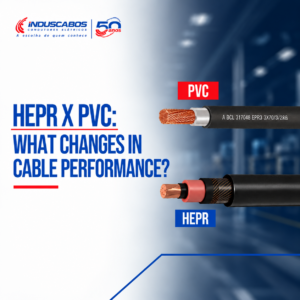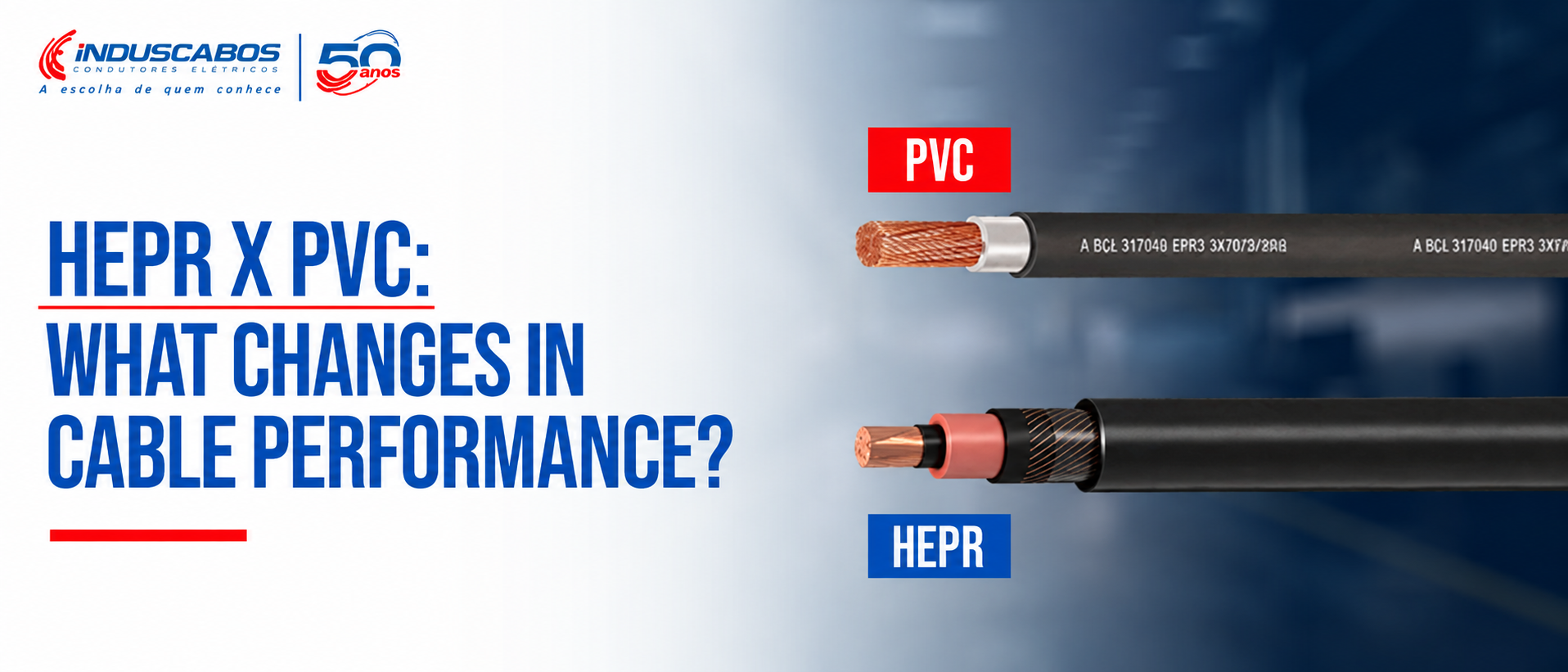
When specifying an electrical project, the choice of cable insulation directly affects operating conditions, how field performance is assessed, and installation sizing. One of the most common comparisons is HEPR vs. PVC, a topic that often raises questions in technical purchasing, engineering, and maintenance.
This comparison should not be based only on the material name. The insulation type changes the operating temperature, the cable’s behavior under load, and the way the installation should be evaluated. Therefore, understanding the difference between HEPR and PVC helps prevent inappropriate choices and align the cable with the project’s actual needs.
In typical applications, PVC is associated with a maximum continuous conductor operating temperature of 70°C, while HEPR can operate continuously at 90°C, depending on the product construction and applicable standard. This difference is relevant, but it does not replace a complete analysis of the conditions of use.
HEPR vs. PVC: how insulation influences performance
Insulation does more than electrically separate conductors. It also contributes to the cable’s thermal behavior, service stability, and the way current can be carried within the limits defined by the design. In other words, insulation directly influences the cable’s operating conditions.
When discussing electrical cable temperature, it is important to distinguish the maximum continuous conductor operating temperature from ambient temperature. The cable’s technical information refers to the conductor under operating conditions, not to the surrounding environment. This prevents incorrect interpretations when specifying the product.
In practice, choosing between PVC insulation and HEPR insulation requires considering the installation as a whole. Voltage, current, ambient temperature, installation method, and circuit grouping are factors that affect thermal behavior and cable sizing.
PVC and HEPR: thermoplastic and thermoset in practice
PVC is a thermoplastic material. This means it softens when heated and can be reshaped under certain processing conditions. From an application standpoint, this characteristic helps explain why the material behaves differently from thermoset insulation under thermal conditions.
HEPR, in turn, is a thermoset material. After manufacturing and curing, it maintains its structure more steadily when exposed to the operating heat expected for the cable. This does not mean it is unaffected by temperature, but rather that its behavior is better suited to applications with higher thermal demands.
This difference between thermoplastic and thermoset cables is one of the foundations for understanding the difference between HEPR and PVC. In typical applications, PVC cable operates with a continuous conductor temperature of up to 70°C, while HEPR cable can operate continuously at 90°C, always according to the product construction and applicable standard.
- Thermoplastic: material that softens with heat and can be reprocessed
- Thermoset: material that, after curing, maintains a more stable structure during operation
- Operating temperature: a reference to the conductor, not the ambient temperature
Where each solution makes the most sense
PVC cable is widely used in low-voltage installations and conventional applications where operating conditions remain within the limits established for this type of insulation. It is a common solution in many electrical contexts and can perform well when the project has been sized accordingly.
HEPR cable is used in cables that require higher thermal performance, including industrial and commercial installations and power circuits. In these cases, the higher permissible conductor temperature can help meet certain design conditions, always within the complete set of technical criteria for the installation.
The difference between HEPR and PVC, therefore, should not be viewed as a question of which is universally superior. The key point is suitability for use. There are projects in which PVC is sufficient and technically appropriate. In others, HEPR makes more sense because of thermal and operational requirements.
Criteria that help with the choice
Before defining the insulation material, it is worth checking whether the cable will be subject to continuous load, temperature variations, spaces with limited ventilation, or sections with a higher concentration of circuits. These factors affect current-carrying capacity and installation sizing.
It is also important to remember that a cable with a higher permissible temperature does not automatically correspond to a higher current in every scenario. Final performance depends on the cable construction, installation method, and actual project conditions.
Temperature, current, and cable sizing
Operating temperature affects how the cable dissipates heat. When the insulation supports a higher continuous temperature, the design may have more margin for certain service conditions. Even so, this margin must be interpreted carefully because cable sizing does not depend only on the insulation material.
In practice, current-carrying capacity results from a set of variables. Insulation is one of them, but not the only one. If the installation is in a hot environment, has many grouped cables, or uses an unfavorable installation method, thermal behavior can change significantly.
Therefore, when comparing HEPR cable and PVC cable, the most appropriate approach is to analyze the project as a whole. The choice should consider circuit voltage, expected current, ambient temperature, installation type, and the thermal performance required throughout operation.
- Check the circuit’s rated voltage
- Evaluate operating current and load profile
- Consider ambient temperature and ventilation
- Review the installation method and cable grouping
- Confirm the product construction and applicable standard
Conclusion: the correct cable is the cable sized for the application
In the HEPR vs. PVC comparison, the most important point is understanding that there is no universally better solution. PVC performs well in many low-voltage installations and conventional applications. HEPR, in turn, is a relevant alternative when the project requires higher thermal performance and insulation with more stable behavior under certain operating conditions.
The technical decision should go beyond nominal temperature. The installation as a whole, the intended application, and the sizing criteria must be evaluated so the cable operates within appropriate limits. This makes the specification safer, more consistent, and better aligned with expected field performance.
In summary, the correct cable is the one that meets the installation’s actual needs without unnecessary oversizing and without compromising electrical safety or system reliability.
Need to specify HEPR or PVC for an industrial project?
When choosing between HEPR insulation and PVC insulation, the ideal approach is to evaluate the complete application scenario in order to select the cable with the most suitable thermal and electrical performance. For technical purchasing, resale, or industrial projects, correct specification helps prevent rework and align the cable with actual operating conditions.
Request a quote for cables with the appropriate specification