In electrical installations, the behavior of a cable when exposed to flame is an aspect that cannot be treated as a secondary detail. In a scenario involving abnormal heating, a short circuit, overload, or insulation failure, cables can cease to be merely energy conductors and begin to influence the spread of a fire along the installation route.
It is in this context that flame-retardant cables become relevant. They are specified to provide flame non-propagation, meaning they are designed to make it more difficult for fire to spread from one section of the cabling to another. This does not mean that the cable is immune to fire, but rather that its behavior can help reduce the electrical system’s contribution to flame spread.
For technical buyers, designers, installers, and maintenance teams, understanding this concept helps support more consistent decisions when specifying electrical cables. The right choice depends on the environment, installation method, voltage, conductor cross-section, and the fire safety requirements applicable to the project.
What are flame-retardant cables and why flame non-propagation matters
Flame-retardant cables are designed to hinder flame propagation along the cable itself when exposed to fire under specified test and application conditions. In practice, this means that the insulation and sheath materials, as well as the cable construction, directly influence how it reacts to heat and flame.
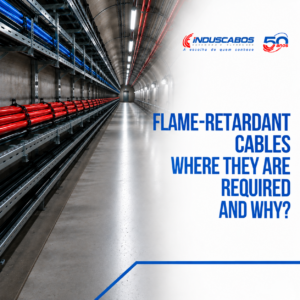
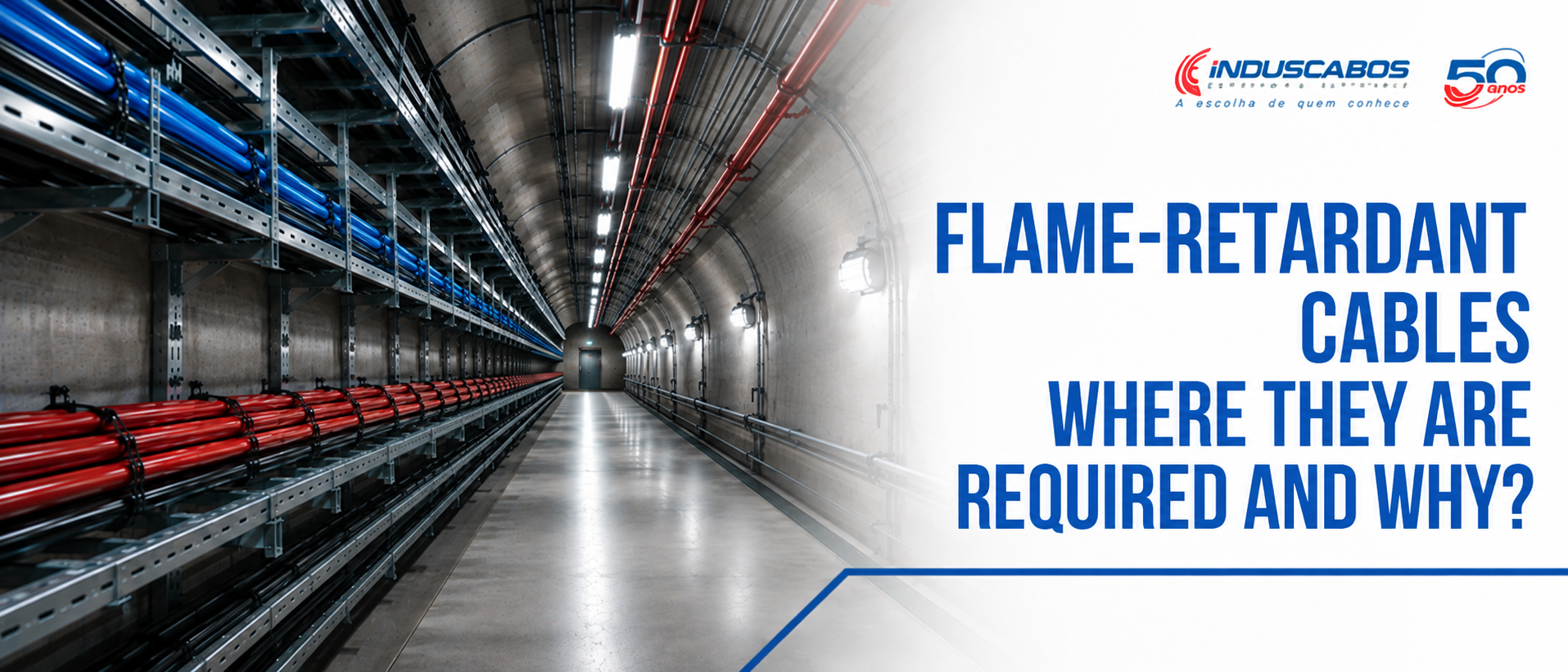
The importance of this behavior lies in the fact that electrical installations extend across large areas of a building or industrial plant. The same group of cables may pass through technical rooms, shafts, corridors, panels, cable trays, cable racks, and production areas. If the material favors flame propagation, the cabling can act as a continuous path for the fire, increasing the extent of the damage.
For this reason, flame non-propagation is an electrical and fire safety criterion. It does not eliminate the need for circuit protection, but it reduces the likelihood that the cable itself will contribute to the spread of fire through successive sections of the installation.
- Reduces the likelihood of fire spreading along the cabling route
- Helps limit the involvement of adjacent sections of the installation
- Complements other electrical and fire protection measures
- It is especially relevant on routes with a high concentration of cables
How cables can contribute to flame spread
When a cable is exposed to an intense heat source, the behavior of the polymeric material used in the insulation and sheath becomes decisive. Some compounds may sustain combustion for longer, promote dripping of burning material, or allow fire to move from one point to another along the cable bundle.
This risk increases in installations with many grouped cables because the proximity between conductors and the presence of trays, shafts, and ducts can create a continuous path for the flame. In other words, it is not only the individual cable that matters, but also how it is installed and the environment in which it operates.
The insulation and sheath materials influence resistance to flame spread, thermal stability, and the cable’s response when exposed to fire. Therefore, electrical cable specification should consider not only electrical performance but also the behavior of the overall cable construction in risk situations.
In industrial and building projects, this point is even more relevant because a circuit failure can have cascading effects. A cable that is unsuitable for the environment can accelerate the loss of sections of the installation, increase material damage, and make the incident more difficult to contain.
Influence of materials on fire response
The composition of the insulation and sheath changes how the cable reacts to heat, flame, and contact with other installation components. In practical terms, this affects the rate of fire spread, the integrity of the cable bundle, and cable behavior in areas with greater exposure.
Flame-retardant cable, fire-resistant cable, and low smoke and gas emission
A common question is the difference between flame-retardant and fire-resistant cables. Although both are related to fire safety, they do not serve the same function. A flame-retardant cable is specified to hinder flame propagation along the cable. A fire-resistant cable, on the other hand, is intended to maintain a certain level of functionality for a period of time under fire conditions, according to the requirements of the project and application.
This distinction is essential to avoid unsuitable choices. A flame-retardant cable should not be understood as “fireproof,” because it can be damaged or destroyed when exposed to a fire. Its role is to reduce the cabling’s contribution to flame spread, not to guarantee continuous operation under any fire scenario.
It is also important to distinguish flame non-propagation from low smoke and gas emission. These characteristics may coexist in certain cables, but they are not synonymous. Low smoke and gas emission relates to the behavior of materials during combustion, while flame non-propagation refers to the cable’s ability not to promote the spread of fire along its length.
In practice, the designer needs to determine which requirement is necessary for the application. In some cases, the focus will be on limiting flame propagation. In others, it will also be necessary to consider smoke, gases, service continuity, or other requirements of the environment and applicable standards.
- Flame-retardant is not synonymous with fire-resistant
- Flame non-propagation is not the same as low smoke and gas emission
- The correct requirement depends on the circuit function and installation environment
- The cable should not be treated as the sole form of fire protection
Where fire behavior should be considered in cable specification
Cable behavior under fire conditions should be considered whenever the installation passes through areas with a higher concentration of people, greater cable density, or higher operational criticality. This applies to commercial and residential buildings, as well as industries, distribution centers, infrastructure, and technical environments with extensive cabling routes.
In corridors, circulation areas, risers, shafts, electrical rooms, panels, indoor substations, technical galleries, and cable racks containing large quantities of cables, the choice of material can influence the extent of damage in the event of a failure. In industrial installations, the issue is also relevant because unplanned shutdowns, loss of circuits, and infrastructure damage can generate significant operational impacts.
Another important point is that fire behavior requirements should not be analyzed in isolation. Circuit voltage and conductor size are essential criteria, but they are not the only ones. The environment, operating temperature, installation method, cable grouping, ventilation, mechanical exposure, and project safety requirements must also be considered.
In well-specified projects, the right cable is one that simultaneously meets the electrical performance and safety conditions required by the application. This avoids choices based solely on price or on an isolated product characteristic.
Practical examples of points requiring attention during specification
In a building with escape routes and high circulation, the behavior of cabling when exposed to flame can be decisive in limiting fire spread. In an industrial plant with extensive cable tray systems, the concentration of cables requires additional attention. In infrastructure and technical areas, system continuity and damage reduction must also be included in the analysis.
In these scenarios, electrical cables should be specified based on clear technical requirements, not only on the circuit’s rated voltage. The correct choice helps align electrical safety, reliability, and suitability for the installation’s actual use.
Technical criteria for choosing flame-retardant cables more safely
When specifying flame-retardant cables, the first step is to understand the circuit function and installation environment. A cable for general power supply, a control circuit, an industrial cable-tray installation, or a route through a circulation area may require different analyses. Fire behavior should be treated as part of the overall set of criteria, not as an isolated attribute.
It is also important to verify the regulatory and project requirements applicable to the application. Standards guide the correct use of cables, the relevant tests, and the expected limits for each installation condition. Following these requirements reduces the risk of improper specification and contributes to an installation that is more consistent with the desired safety level.
Another important precaution is not to confuse the function of the cable with the function of protective devices. Flame-retardant cables do not replace proper sizing, overcurrent protection, circuit coordination, or correct installation. If the cable is incorrectly sized, improperly installed, or subjected to conditions outside those for which it was designed, the performance of the solution will be compromised regardless of its flame-retardant characteristics.
In practice, the technical decision should consider:
- Circuit voltage and conductor cross-section
- Installation environment and operating temperature
- Installation method and degree of cable grouping
- Fire behavior requirements of the application
- Electrical project standards and criteria
- Need for complementary circuit protection
This more comprehensive approach prevents the cable selection from being overly simplified, which could compromise the safety and reliability of the installation over time.
Conclusion: proper specification, safety, and reliability go hand in hand
Flame-retardant cables play an important role in reducing flame spread in electrical installations, especially when cabling runs through extensive areas or concentrates many circuits. By making it more difficult for fire to spread along the cable itself, they help limit damage and support the project’s fire safety strategy.
However, this characteristic must be understood in the correct context. Flame-retardant does not mean fireproof, is not synonymous with fire-resistant cable, and does not replace low smoke and gas emission when that requirement is necessary. Each attribute addresses a specific need and must be evaluated according to the application.
Therefore, electrical cable specification must go beyond voltage and conductor size. Materials, environment, installation method, regulatory requirements, and the expected safety level of the installation must all be considered. When these factors are analyzed together, the project gains in reliability, performance, and technical suitability.
Request flame-retardant cables with specifications suited to your project
If your application requires attention to cable behavior under fire conditions, the solution should be evaluated based on the environment, installation, and technical requirements of the project. The right choice helps reduce risks, preserve installation reliability, and align the cabling with the needs of industrial and building applications.
Request a quote for flame-retardant cables for your installation