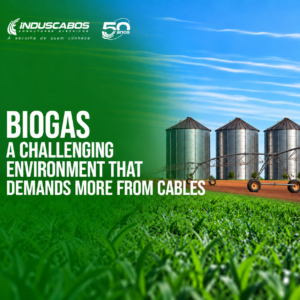
In biogas plants, the electrical infrastructure must support an operation that is typically continuous, distributed and sensitive to environmental variations. Therefore, choosing electrical cables for biogas cannot be treated as a decision based only on rated voltage or conductor cross-section. The project must consider the actual context of each section of the installation and the function of each circuit.
This type of plant includes equipment such as motors, pumps, compressors, panels, control systems and instrumentation. In many cases, these elements operate continuously and depend on a reliable power supply to maintain process stability. When cable specification does not match this reality, the risks of corrective interventions, unplanned shutdowns and maintenance difficulties increase.
In addition, a biogas or biomethane plant may include areas with very different characteristics. Some sections are more protected, while others are exposed to moisture, thermal variations, chemical agents or mechanical stresses. This diversity reinforces the need to assess each circuit individually, focusing on the application and installation conditions.
How the electrical infrastructure of a biogas plant influences cable selection
A biogas and biomethane plant combines process stages, automation and electrical distribution. In practice, this means that the internal network must serve power, control and instrumentation circuits with different requirements. Electrical cables for biogas may be used to supply motors, pumps and compressors, distribute power between panels and load centers, and carry signal and control circuits that support system operation.
This organization requires a technical reading of the project. A cable intended to supply a motor does not necessarily meet the needs of an instrumentation circuit with the same performance. Likewise, a low-voltage distribution section may require a different construction from that used in a medium-voltage interconnection. Correct specification begins with an analysis of circuit function, installation method and environmental conditions.
In industrial applications, cable selection must also consider operational continuity. In plants with continuous operation, any limitation in the electrical infrastructure can affect the process as a whole. Therefore, selection should go beyond basic electrical compatibility and consider how the cable behaves in the actual operating environment.
- Power supply for motors, pumps and compressors
- Low- and medium-voltage power distribution
- Control circuits for automation and command
- Instrumentation circuits for monitoring and signaling
- Sections with different installation and exposure conditions
Voltage and conductor cross-section are not the only selection criteria
When specifying electrical cables for biogas, initial attention commonly focuses on rated voltage and conductor cross-section. These parameters are important, but they do not complete the analysis. In an industrial plant, the cable must be compatible with the environment, the type of circuit and how it will be installed. This applies to both low-voltage and medium-voltage cables, depending on the project architecture.
Site temperature can influence the performance of the electrical system and how the cable should be selected. In hotter areas or locations subject to thermal variations, the specification must consider actual operating conditions and the possibility of additional heating caused by the circuit itself. The goal is not to assume a single scenario for the entire plant, but to assess where the cable will be installed and what stresses it will face.
The installation method is also decisive. Cables installed in cable trays, conduits, ladder trays, underground routes or exposed pathways may face different conditions for heat dissipation, maintenance access and mechanical protection. In other words, the same electrical application may require different constructions depending on the route the cable follows through the plant.
At this point, electrical cable specification stops being merely a purchasing step and becomes part of the project. When sizing considers actual installation conditions, the electrical infrastructure tends to be more consistent with the facility’s operating routine.
Moisture, chemical agents and temperature: why the environment needs careful analysis
In biogas plants, moisture may be present at certain process points, in washdown areas, outdoors or in sections subject to condensation. This does not mean that the entire plant is exposed to the same moisture level, but it does mean that the specification must identify where this factor actually exists. In locations with greater presence of water or vapor, the cable sheath and construction should be carefully assessed to avoid performance loss over time.
Potential exposure to chemical agents also deserves specific analysis. Depending on the plant area, there may be substances that require greater care when selecting the sheath and cable protection materials. The point is not to generalize that every biogas environment is harsh, but to recognize that some sections may come into contact with compounds that change the technical requirements of the installation.
Temperature is another factor that should not be treated abstractly. In industrial environments, thermal variation can affect system performance and the choice of cable construction. Therefore, the assessment should consider the condition of each section, site ventilation, proximity to equipment and the installation method. When these elements are ignored, the specification may become misaligned with actual field conditions.
In industrial projects, different plant areas commonly have different requirements. An indoor, protected section may require a different solution from one used outdoors or at a process point with greater environmental exposure. This zone-by-zone assessment is essential for electrical cables for biogas to be specified consistently with the project.
- Localized moisture or condensation at specific points
- Possible contact with chemical agents in specific areas
- Temperature variations according to environment and process
- Need to assess each plant section separately
Mechanical stresses and installation method are also part of the specification
In addition to environmental conditions, the installation can impose significant mechanical stresses on the cable. Passages through structures, routes with vibration, movement points, areas with frequent maintenance and sections with a greater risk of friction are examples of situations that require attention. In an industrial plant, mechanical resistance should not be assumed; it must be compatible with the installation method and expected exposure.
This care is important because a cable may be electrically correct and still not be the most appropriate choice for a given route. If the section requires greater robustness, the cable construction must meet that demand. In severe environments or areas with harsher characteristics, industrial electrical cable selection should consider not only electrical performance but also the physical integrity of the assembly throughout operation.
That is why specification should not be standardized across the entire plant. The cable used in a protected power feed may be different from the one applied in an exposed circuit, and both may perform equally important functions. Correct analysis of the installation method helps avoid generic choices that do not reflect the actual project conditions.
When the project considers these aspects from the beginning, the electrical infrastructure tends to be better aligned with operation. This helps reduce unnecessary interventions and keeps the plant more predictable from both electrical and maintenance perspectives.
Cables for power, control and instrumentation: each circuit requires a different approach
In a biogas plant, power, control and instrumentation circuits should not be treated in the same way. Cables for motors, pumps and compressors, for example, must meet power demand and the conditions of the electrical route. Control circuits require attention to command continuity and automation organization. In instrumentation circuits, the priority is typically signal integrity and suitability for the environment where the cable will be installed.
This difference in function directly influences cable construction. Depending on the application, PVC, EPR, HEPR, XLPE or EPR 105 insulation may be specified, always according to project and circuit characteristics. It is also important to assess sheaths suitable for the industrial environment, especially where there is exposure to moisture, thermal variations, chemical agents or mechanical stresses.
In other words, the right cable for a power circuit is not necessarily the same cable indicated for instrumentation. The same reasoning applies to low voltage and medium voltage, which may coexist in the same plant with different requirements. The technical specification must reflect this diversity so that the electrical infrastructure supports the process consistently.
When selection is based on the actual application, the project gains consistency. This applies to new plants as well as expansions, retrofits and upgrades to existing installations.
- Cables for motors, pumps and compressors
- Cables for control and automation circuits
- Instrumentation cables for signal and monitoring
- PVC, EPR, HEPR, XLPE or EPR 105 insulation according to the application
- Sheaths suitable for the industrial environment
Conclusion: proper specification is part of plant reliability
The specification of electrical cables for biogas should reflect the reality of each plant and each section of the installation. Temperature, moisture, possible chemical agents, mechanical stresses, installation method and circuit function are factors that need to be analyzed together. When this assessment is technical, the electrical infrastructure tends to be better aligned with operation and process requirements.
In biogas and biomethane plants, this attention is especially relevant because operation usually involves critical equipment and different levels of environmental exposure. Therefore, industrial electrical cable selection should not be standardized simplistically. The project must consider actual conditions of use so that the specified solution is compatible with the application.
Correct specification does not eliminate all operational risks, but it makes an important contribution to system reliability, operational continuity and technical suitability. In severe environments, this decision is part of plant efficiency and the organization of the electrical project as a whole.
Request biogas cables with specifications aligned with your project
If your plant requires analysis by circuit, environment and installation method, it is worth working with a manufacturer that operates with low and medium voltage and different industrial applications. Induscabos can support projects that require electrical cables for biogas, biomethane, motors, pumps, control and instrumentation, always focusing on technical compatibility with the application.
To move forward with a specification suitable for your project, request a quote and provide the electrical and environmental conditions of the section to be served.
Request a quote for cables for biogas and industrial applications