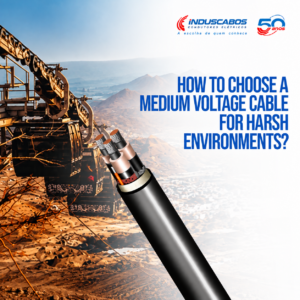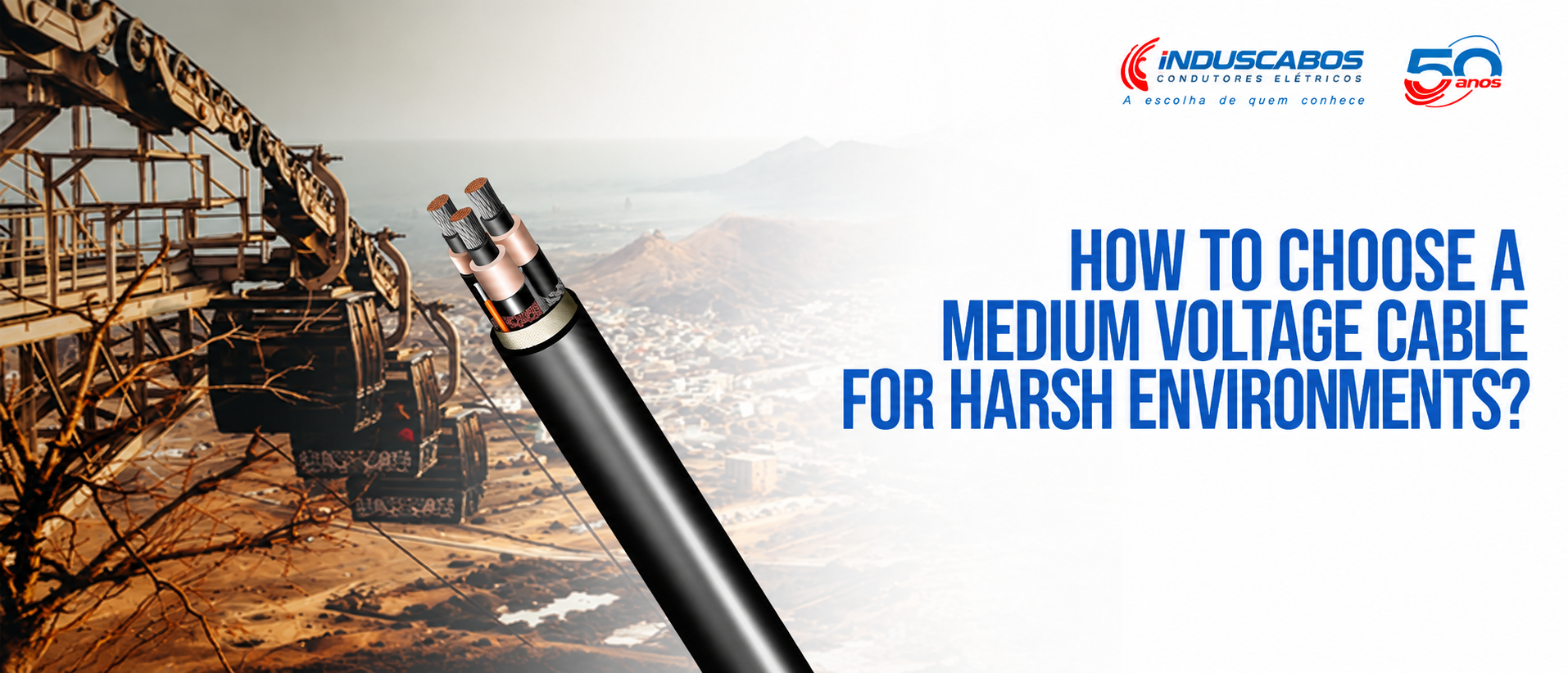
Choosing a medium-voltage cable for harsh environments requires an analysis that goes beyond rated voltage and conductor cross-section. In many industrial installations, actual operating conditions are just as important as the electrical design because the environment directly affects cable performance over time.
When moisture, heat, chemical agents or mechanical stresses are present, the specification must consider how these factors affect the insulation, sheath and overall cable construction. Ignoring these variables can compromise system reliability and increase the risk of unplanned interventions.
For this reason, medium-voltage cable for harsh environments should be selected based on installation characteristics, environmental conditions and the application method. This technical approach helps align safety, operational continuity and suitability for industrial use.
Why the environment is part of the specification
In practice, the environment is also part of the electrical cable specification. A cable may meet the design requirements in terms of rated voltage and conductor size but still be unsuitable if it is exposed to severe operating conditions. For medium-voltage cables, this is even more relevant because the installation is often associated with critical systems that require stability and reliability.
Harsh environments can alter the behavior of materials around the cable and accelerate wear that may not appear in a simplified analysis. Constant moisture, high temperature, the presence of chemical substances and vibration are examples of factors that need to be assessed before defining the solution.
In other words, electrical cable specification should consider the combination of design, environment and operation. When this assessment is complete, selection tends to be more consistent with actual field conditions and the requirements of the electrical system.
- Environmental conditions at the installation site
- Operating requirements of the electrical system
- Compatibility between cable construction and application
- Risks associated with continuous exposure
Moisture, heat and chemical agents: what to assess before choosing
Moisture is one of the most common factors in harsh environments and should be carefully analyzed. Depending on the installation, the presence of water, condensation or infiltration can affect material behavior and require greater care in selecting the insulation, sheath and protections associated with the cable.
In high-temperature locations, the challenge is different. Continuous heat can impose greater thermal stress on the system and require cable construction that is compatible with this condition. This applies both outdoors and in indoor areas with limited heat dissipation or proximity to heat sources.
The presence of chemical agents requires a specific analysis because certain compounds can affect the outer sheath and other elements of the cable construction. In industrial plants, process areas and installations near corrosive products, this assessment is an essential part of the specification.
These environmental and operating conditions should be known before the final selection. The more detailed the site assessment, the greater the chance of selecting cables for severe environments that truly match the application requirements.
Mechanical stresses and physical installation conditions
In addition to the chemical and thermal environment, the installation can impose relevant mechanical stresses. Tension, compression, bending, vibration and friction are examples of loads that affect industrial cable performance during installation and throughout operation.
In some scenarios, the cable runs through cable trays, ducts, raceways, trenches or sections subject to movement and physical interference. In these cases, mechanical cable protection may be necessary to preserve installation integrity and reduce wear caused by contact with surfaces, equipment or structures.
The correct choice must consider whether the cable will be exposed, buried, protected by conduit or installed indoors under more stable conditions. Each situation changes the type of stress applied to the assembly and may require different cable constructions and characteristics.
Therefore, there is no single solution that is valid for every harsh environment. The construction must be compatible with installation characteristics, including how the cable will be handled, secured and operated on a daily basis.
- Tension and bending during installation
- Vibration and movement of the assembly
- Friction against structures and supports
- Need for additional mechanical protection
The role of insulation, sheath and additional protections
Cable insulation plays an essential role in electrical separation between conductors and in medium-voltage system performance. It must be compatible with design requirements and the operating conditions expected for the installation, especially where environmental variations or more severe stresses are present.
The cable sheath, in turn, acts as an outer protective layer and contributes to the assembly’s resistance to external agents. It does not perform the same function as insulation, but complements the construction by helping protect against moisture, abrasion, contact with surfaces and other environmental factors.
In certain applications, cable construction may require additional protections. This occurs when the environment is more severe or when the installation exposes the cable to specific risks that cannot be addressed by the basic configuration alone. In these cases, the technical analysis should consider the full set of requirements rather than a single isolated requirement.
This approach is especially important for medium-voltage cables because improper selection of materials or protective layers can compromise the cable’s suitability for its intended use. Compatibility between insulation, sheath and application is a central part of the specification.
The importance of the installation method
The installation method directly influences the stresses placed on the cable. The same medium-voltage cable can face very different conditions depending on where and how it is installed. An exposed section, for example, may be more subject to heat and environmental radiation, while a buried section may face moisture, soil pressure and difficulties with heat dissipation.
It is also necessary to assess whether the installation will use trays, ducts, cable trays, technical galleries or other configurations. Each method changes the level of physical protection, ventilation, ease of maintenance and the type of mechanical stress applied to the cable.
Therefore, medium-voltage cable installation should not be treated as a generic step. The selected method must be known before specification because it affects the selection of the most appropriate construction and the assessment of the project’s environmental and operating conditions.
When this analysis is performed carefully, the result tends to be an installation that is more consistent with actual use, reducing incompatibilities between the cable and the environment in which it will operate.
- Exposed or protected installation
- Buried sections or sections in ducts
- Indoor or outdoor environments
- Ease of maintenance and inspection
Why rated voltage and conductor size are not enough
Considering only rated voltage and conductor cross-section is not enough to choose a medium-voltage cable for harsh environments. These parameters are important, but they do not cover all electrical system requirements or reflect actual operating conditions.
A correct specification needs to integrate the electrical design, environmental characteristics, installation method, mechanical stresses and particularities of the production process or infrastructure. In an industrial environment, this approach is essential because the cable must operate compatibly with the scenario in which it will be used.
Different environments may require different cable constructions and characteristics. A location with moisture and outdoor exposure may require a different solution from one used indoors with heat and chemical agents. The same applies to installations with vibration, movement or a need for additional mechanical protection.
When the analysis is reduced to only a few parameters, the likelihood of functionally underspecifying the solution increases—not necessarily in terms of current, but in terms of suitability for the environment. For industrial cables, this difference is decisive for system reliability.
Conclusion: specifying based on the environment reduces risks and improves operation
Choosing a medium-voltage cable for harsh environments should begin with a complete assessment of the installation. Moisture, high temperatures, chemical agents, mechanical stresses and installation method are factors that directly influence cable performance and must be considered before the final definition.
By properly assessing the insulation, sheath and any additional protections, the designer or technical buyer improves the solution’s fit with actual field conditions. This helps reduce failure risks, support electrical safety and sustain more reliable and continuous operation.
For industrial applications, proper specification is not merely a documentation step. It is part of the system reliability strategy and helps avoid generic choices that do not meet environmental requirements.