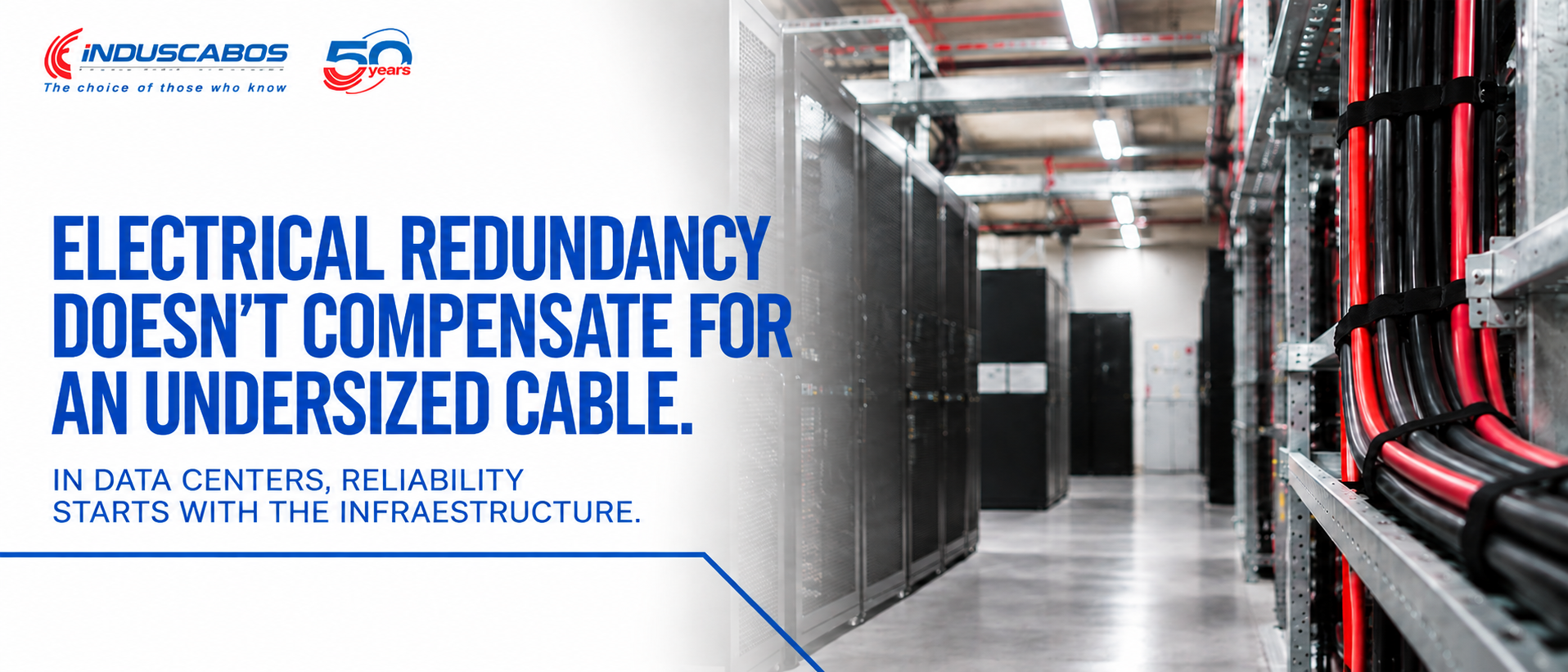
In highly critical electrical infrastructure projects, cable sizing in Data Centers must be treated as a central part of system reliability. Electrical redundancy alone does not correct inappropriate cable choices, nor does it compensate for a circuit that was specified outside actual operating conditions.
In a Data Center, operational continuity depends on an architecture designed to support high loads, demand variations and contingency scenarios. Therefore, resources such as UPS systems, generators, redundant power feeds and alternative power routes are important, but they do not replace proper attention to each section of the electrical distribution system.
When a cable is not sized according to design current, ambient temperature, conductor grouping and the installation method, the circuit may operate under conditions different from those anticipated. This affects electrical losses, heating, voltage drop and even insulation service life, with a direct impact on the electrical reliability of the installation.
What electrical redundancy means in Data Centers
In the context of Data Centers, electrical redundancy is the strategy of maintaining alternative power paths to reduce dependence on a single power point. In practice, this may involve UPS systems for temporary support, generators for utility failures, redundant feeds for critical loads and alternative routes that allow continuity during maintenance or contingency situations.
This approach is common in critical infrastructure environments because operation cannot depend on a single path. If part of the system needs to be isolated, maintained or replaced, another route must take over the function defined in the design without interrupting essential operations.
This is where paths Load and B come into play, commonly used to organize redundant electrical distribution. In practical terms, each path serves part of the architecture or acts as a backup for specific situations. The key point is that both must be designed as real circuits, with their own performance requirements, rather than merely as a conceptual copy of the main system.
Electrical redundancy is therefore related to system availability and continuity. It helps reduce the impact of failures, maintenance and transfers between sources, but it does not change the physical and electrical requirements that each circuit must meet.
Why a redundant path also needs correct sizing
A common design mistake is to assume that because a redundant path exists, the cable in that section can be treated with less rigor. In practice, this does not make technical sense. If path A or B is activated under a contingency condition, it must support the expected current, keep voltage drop within acceptable limits and operate without exceeding limits that compromise performance.
The sizing of electrical cables must consider the circuit design current, how power will be distributed and the installation conditions. An undersized cable may experience excessive heating, higher-than-expected electrical losses and additional stress on the insulation. In continuous-operation environments, this type of deviation should not be treated as a secondary detail.
In addition, cable selection should not be based only on cost or minimum design margin. In Data Centers, electrical infrastructure must respond to different load conditions and source-transfer scenarios. This requires a technical specification compatible with the criticality of the environment, not merely a solution that “works” on paper.
- Design current compatible with the expected load
- Ambient temperature considered in the calculation
- Cable grouping assessed in the installed section
- Installation method compatible with heat dissipation
- Voltage drop within design limits
- Current-carrying capacity suitable for the circuit
Factors that influence cable sizing in Data Centers
The cable sizing in Data Centers cannot be based on a single variable. It depends on the relationship between load, environment, installation and expected circuit behavior throughout operation. In a high-energy-density environment, small design differences can alter the thermal and electrical performance of the power path.
Design current
Design current is the starting point for any specification. It represents the demand that the circuit must meet under the expected conditions. If this current is underestimated, the cable may operate near or above its limit, compromising system stability and increasing the risk of heating.
Ambient temperature
Ambient temperature directly influences the cable’s heat dissipation capacity. In locations with higher thermal loads, the thermal safety margin may be reduced, requiring greater design attention. In Data Centers, where the infrastructure already operates alongside heat-generating equipment, this factor should not be ignored.
Cable grouping
When cables are installed together, heat dissipation changes. Grouping can raise operating temperature and reduce the current-carrying capacity available to each circuit. Therefore, the physical arrangement of the installation must be assessed together with the rest of the electrical design.
Installation method
The installation method affects ventilation, heat exchange and how the cable behaves along its route. Installations in cable trays, ladder trays, shafts or other technical pathways may present different conditions. Cable sizing must reflect this reality rather than only a generic theoretical condition.
Voltage drop and electrical losses
Voltage drop is another decisive factor. In long circuits or circuits with high loads, an unsuitable cable can generate greater electrical losses, affecting the performance of the supplied system. In a Data Center, this is especially relevant because the power supply must remain stable to preserve operational continuity.
When these factors are combined incorrectly, the result may be a cable operating under more severe conditions than anticipated. This does not mean that failure will occur immediately, but it indicates that the installation will be more exposed to thermal and electrical stress over time.
Load transfer and circuit behavior during contingencies
A transfer is one of the most sensitive moments in Data Center electrical infrastructure. When part of the system stops operating or needs to be isolated, another path assumes the condition foreseen by the design. In this scenario, the circuit that remains active must continue operating within established limits without exceeding the parameters for which it was sized.
This applies to paths A and B as well as other redundant power architectures. The existence of an alternative route does not eliminate the need for each section to be prepared for its function. If the transfer occurs under higher demand, the cable must withstand that condition without compromising overall stability.
In practical terms, redundancy protects system availability, while correct sizing ensures that the electrical path is capable of carrying power safely. These are different but complementary functions. A robust design depends on both at the same time.
If the cable is not suitable for the transfer condition, temperature may rise, losses may increase and insulation service life may be reduced. In a continuous-operation environment, this affects system predictability and makes electrical infrastructure management more difficult.
Electrical reliability in critical infrastructure requires more than a plan B
Data Centers operate with high energy demand and must sustain different load conditions over time. This makes electrical infrastructure a strategic element of the design, not merely a set of supporting components. Electrical reliability depends on consistency between architecture, specification and execution.
Having electrical redundancy is important, but it is not enough. The system must be designed so that each power path delivers performance compatible with its function. This includes Data Center cables selected based on technical criteria, not only commercial availability or lower initial cost.
In critical infrastructure projects, cable selection influences the stability of power distribution, heat dissipation, operating margin and maintenance over time. When the design respects these factors, operation tends to be more predictable and better aligned with environmental requirements.
Therefore, the discussion should not be “redundancy or sizing,” but “redundancy and sizing.” One does not replace the other. Operational continuity depends on the power architecture, while circuit safety depends on correct specification of cables and the other installation components.
Conclusion
Electrical redundancy is an essential strategy for Data Centers because it increases availability and creates alternative power paths. However, it does not compensate for a poorly sized cable. Each A and B path, each power route and each contingency circuit must be specified according to design current, ambient temperature, cable grouping, installation method, voltage drop and current-carrying capacity.
When sizing is inadequate, the circuit may operate with excessive heating, greater electrical losses and increased stress on the insulation. In critical infrastructure, this should not be treated as a construction detail, but as part of system reliability engineering.
In summary, reliability does not depend only on having a plan B. The different power paths must also be correctly specified and sized to sustain continuous operation safely and with proper performance.
Specify Data Center cables with a focus on performance and operational continuity
If your project requires redundant power, load transfer and high electrical reliability, cable selection must match the criticality of the application. Induscabos provides power-distribution solutions for environments that demand consistent technical specification, project support and attention to actual installation conditions. Requesting a quote is an important step in aligning the right cable with your Data Center requirements, avoiding choices based only on price and reducing the risk of incompatibility with the design.
Request a quote for Data Center cables