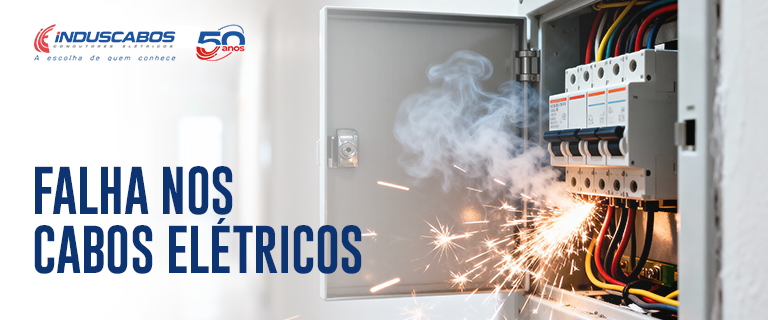
A short circuit may last only a fraction of a second. Even so, during that brief interval, an electrical cable may be subjected to conditions far more severe than those encountered during normal operation.
The current increases rapidly, the conductor temperature rises, and thermal and mechanical stresses develop that can compromise the installation if the system has not been properly designed.
But what actually happens to the cable during a short circuit?
Why does the current increase so much during a short circuit?
Under normal conditions, electric current flows through a circuit at values established during the design stage. In a short circuit, a low-impedance connection occurs between points at different electrical potentials.
As a result, the current can reach values many times higher than the normal operating current.
This increase occurs very quickly and remains until the protective device, such as a circuit breaker or fuse, interrupts the circuit.
It is precisely during this interval that the cable must withstand extreme conditions.
The conductor heats up rapidly
One of the main effects of a short circuit is the sudden increase in conductor temperature.
Any current flowing through a conductor produces heat due to its electrical resistance. Since short-circuit current is very high, the amount of thermal energy generated also increases significantly.
Therefore, when sizing a cable, it is not enough to consider only the current it must carry continuously. It is also necessary to verify its ability to withstand the short-circuit current during the time required for the protection device to operate.
Conductor materials, insulation type, nominal cross-sectional area, and fault duration are among the factors that influence this behavior.
The insulation is also subjected to stress
The heating of the conductor directly affects the insulation system.
Materials used in cable insulation have defined temperature limits for normal operation, overload, and short-circuit conditions.
During a fault, the temperature can rise rapidly. If the limits specified for the cable are exceeded, accelerated aging, deformation, or damage to the insulation system may occur.
This is why industrial cables are designed considering not only continuous operation, but also exceptional conditions to which they may be subjected.
A short circuit also generates mechanical stress
The problem is not only thermal.
Very high currents produce intense magnetic fields around the conductors. The interaction between these fields can generate significant electrodynamic forces.
In power cable installations, these forces can cause movement and stress on cables, supports, terminations, and other components.
For this reason, the way cables are installed and secured must also take into account the conditions that may occur during a fault.
What about medium-voltage cables?
In medium-voltage systems, there is another important element: the metallic shield.
In cables such as Induscabos’ Epronax Slim 105, the construction includes semiconductive layers, EPR insulation, and a metallic shield formed by copper wires.
Depending on the system configuration and type of fault, this shield may be subjected to current flow. Therefore, its sizing and the correct implementation of the grounding system are also part of the installation engineering.
Like the main conductor, these components must be considered according to the electrical characteristics of the system.
Protection and cable must work together
The behavior of the cable during a short circuit shows why the design of an electrical installation should not consider each component in isolation.
The cable must withstand the fault current for the expected period, while the protective device must interrupt that current within the appropriate time.
The higher the current and the longer it continues to flow, the greater the thermal energy to which the cable will be subjected.
Therefore, knowing parameters such as short-circuit current, protection operating time, conductor cross-sectional area, material, and insulation characteristics is essential for correctly specifying the cables in an installation.
A short circuit may last only a short time, but its effects are intense. Proper specification helps ensure that cables, protective devices, and other system components are prepared to respond safely when a fault occurs.
Request cables suitable for your project’s level of demand
If your project needs to consider short-circuit current, protection coordination, and electrical performance in an industrial environment, the cable specification should be evaluated carefully from a technical standpoint. Induscabos serves the B2B market with a focus on electrical applications that require reliability, support for proper sizing, and suitability for the intended use.
Request a quote for cables for applications with short-circuit requirements