What Does the Information Printed on Electrical Cables Mean?
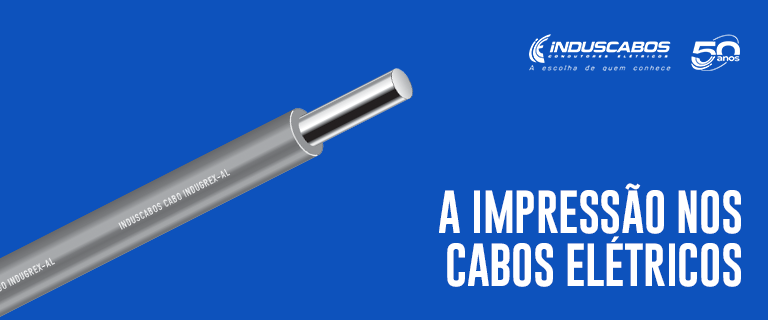
When looking at an electrical cable, it is common to find a sequence of information printed along its outer covering. Although many people do not pay attention to these details, they are essential for identifying the product’s characteristics, ensuring the correct application, and confirming compliance with technical standards.
On Induscabos cables, these markings act as the product’s true identity, providing essential information for installers, engineers, electricians, and distributors.
Why do cables have printed markings?
The marking applied to the cable covering is primarily intended to make the product easier to identify during installation and throughout its service life.
This information makes it possible to quickly check important characteristics, such as conductor size, rated voltage, and the responsible manufacturer, reducing application errors and increasing installation safety.
In addition, the marking supports maintenance, inspection, and future electrical network expansion work.
Manufacturer name or brand
One of the first pieces of information found on the cable surface is the manufacturer’s identification.
Example: INDUSCABOS
This marking confirms the product’s origin and makes it possible to trace where it came from, providing greater assurance for installers and consumers.
Manufacturer identification is also an important indication of quality because it shows that the cable was produced under controlled processes and in accordance with applicable standards.
Cable type or trade name
After the brand identification, the product line or model name usually appears.
Example: DUFLEX
This information helps professionals quickly identify the cable’s construction characteristics, such as flexibility, insulation type, and recommended application.
On projects that use different types of cables, this identification makes it easier to separate materials and prevents confusion during installation.
Rated voltage
The rated voltage indicates the operating range for which the cable was designed.
Example: 450/750 V
This information means that the cable may be used in electrical installations compatible with this voltage class, as provided for in the applicable technical standards.
Choosing the correct voltage rating is essential to ensure installation safety and performance.
Nominal cross-sectional area or conductor size
One of the most important pieces of information printed on the cable is its nominal cross-sectional area, commonly referred to as the conductor size.
Examples:
The conductor size indicates the cross-sectional area of the conductor and is directly related to its electrical current-carrying capacity.
Some practical examples:
- 1.5 mm²
- 2.5 mm²
- 4 mm²
- 6 mm²
- 10 mm²
Lighting circuits.
General-purpose outlets.
Higher-power equipment.
Electric showers and air-conditioning systems.
Distribution board feeders and higher electrical loads.
Correctly identifying this information helps prevent overloads and provides greater installation safety.
Certifications and standards
Depending on the product line, references to applicable technical standards may also appear.
Examples:
- NBR NM 247
- NBR 7288
- Inmetro certification
These markings demonstrate that the product meets the quality, safety, and performance requirements established for its sale and use.
Traceability information
Some cables may contain additional production-related data, such as:
- Manufacturing batch;
- Production date;
- Internal traceability code.
This information makes it possible to quickly identify the product’s origin and supports quality control and any necessary inspections.
How do cable markings make an electrician’s work easier?
Continuous printing on the cable covering offers several advantages:
- Quick identification during installation;
- Fewer application errors;
- Greater safety when assembling circuits;
- Easier future maintenance;
- Confirmation of product compliance.
In large installations, where different conductor sizes and cable types are used at the same time, this information makes the work much more efficient.
The importance of using cables with clear identification
Cables without markings or with incomplete information make it difficult to verify the product’s origin and technical characteristics, which may compromise installation safety.
For this reason, when choosing an electrical cable, it is important to check whether it displays clear, legible, and permanent information along its entire length.
On Induscabos cables, the printed identification was developed to provide convenience, traceability, and confidence, allowing professionals to quickly access the product’s main characteristics directly at the job site.
Do you need cables with proper technical identification for your project?
If your company works with electrical distribution, installation, or specification, using clearly identified cables makes technical verification, traceability, and the selection of the right product for each application easier. Induscabos serves the B2B market with a focus on solutions for industrial projects and can support your supply needs with guidance suited to the intended use.
Request a quote for electrical cables with technical specifications