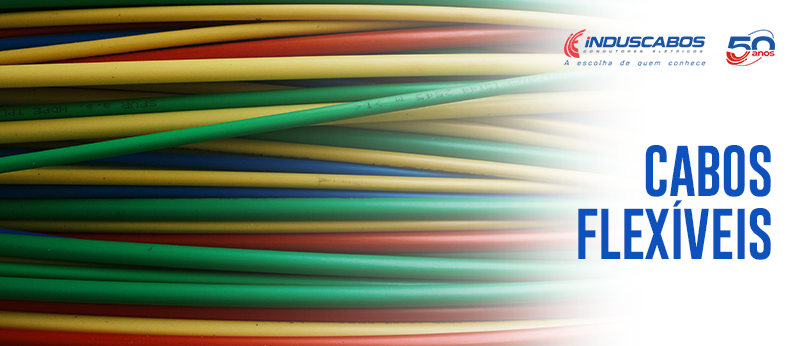
When talking about flexible cables, it is common to associate this type of conductor with mobile equipment or applications that require constant movement. However, flexibility can also provide important advantages in fixed electrical installations, especially during installation.
In practice, flexible cables can make the installer’s work easier, particularly along routes with bends, conduits, panels, and confined spaces. However, it is important to understand that “flexible” primarily refers to the construction of the conductor and does not necessarily mean that the cable was designed for continuous movement.
What makes a cable flexible?
The main difference lies in the construction of the conductor.
While more rigid conductors are made up of fewer wires with larger diameters, flexible conductors use a greater number of thinner stranded wires. This construction makes the cable easier to bend and position during installation.
For this reason, one of the most noticeable practical advantages is easier handling. Induscabos itself highlights that flexible cables are easier to install around bends, through conduits, and inside panels.
What are the advantages in a fixed installation?
In installations with complex routing, flexibility can reduce the effort required to position the conductors. This is especially relevant in electrical panels, trays, cable trays, and conduits with changes in direction.
The main benefits include easier cable pulling, better accommodation around bends, and less difficulty positioning cables inside switchboards and panels.
Depending on the cable construction, the minimum bending radius required for certain bends may also be reduced, contributing to more compact installations.
The Eproflex 90 line, for example, uses flexible stranded conductors and was specifically developed for power supply and distribution circuits in fixed installations. These cables can be installed in ducts, channels, trays, racks, outdoors, or even directly buried, according to the conditions specified for the product.
Flexibility does not mean greater current-carrying capacity
An important point is to avoid a common misconception: a cable does not carry more current simply because it is flexible.
The current-carrying capacity depends on factors such as the conductor’s nominal cross-sectional area, material, insulation type, temperature, and installation conditions.
Therefore, the choice must consider the entire electrical project. It is also worth checking the Induscabos blog article How to Correctly Specify an Electrical Cable.
Insulation also makes a difference
In addition to conductor flexibility, other construction elements can provide practical advantages.
The Eproflex 90, for example, uses 90 °C HEPR thermosetting insulation. This characteristic allows the conductor to operate at 90 °C under continuous service conditions, as well as under specific overload and short-circuit conditions. Its PVC outer sheath also provides abrasion resistance and a low coefficient of friction, contributing to easier installation.
Ease of installation with the correct specification
Using a flexible cable in a fixed installation can provide significant practical benefits, especially in circuits with bends and limited spaces.
Even so, flexibility is only one of the selection criteria. Voltage, current, temperature, installation method, and environmental conditions must also be considered during cable sizing.
By combining proper technical specification with a construction that facilitates installation, it is possible to achieve a more efficient, organized, and safe electrical installation.
Specify the right cable for your fixed installation
If your project requires easier installation, routing through conduits, organization within panels, or adaptation to complex paths, cable selection should consider more than just conductor flexibility. Induscabos serves the B2B market with a focus on technical specification, electrical safety, and suitability for each application, supporting resellers, distributors, installers, and companies in selecting the most appropriate cable for each requirement.
Request a quote for electrical cables with the appropriate technical specification