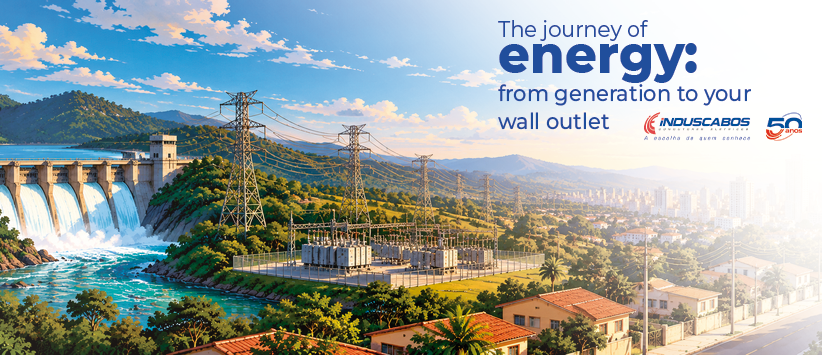
Understanding how electricity reaches our homes helps reveal the complexity behind something that seems simple in everyday life. Before a light is switched on, a piece of equipment is powered up, or a machine is put into operation, electricity follows a path that involves generation, transmission, voltage transformation, and distribution.
This journey is part of a broad energy infrastructure that connects power plants, transmission lines, electrical substations, urban networks, and internal installations in homes, businesses, and industrial facilities. At every stage, electrical cables and conductors play a decisive role in ensuring continuity, safety, and performance.
For technical professionals and the B2B market, understanding this flow is important not only for general knowledge but also when specifying materials, planning projects, and assessing installation reliability. Selecting the right components directly affects system efficiency and the reduction of operational risks.
How electricity reaches our homes: from generation to the Brazilian power system
The starting point is electricity generation. In Brazil, electricity is produced from different sources, such as hydroelectric, wind, solar, and thermal power. Each converts a form of energy into electricity, which must then be delivered to demand centers.
The Brazilian power system was structured to integrate these sources and transport energy over long distances. In practice, this means that electricity generated at a power plant can supply cities, industrial areas, and developments located in regions far from where it was produced.
This model requires coordination between generation, transmission, and distribution. It is not just a matter of producing energy, but of keeping it available with stability, quality, and the capacity to meet demand across different load profiles.
Throughout this chain, the cable and conductor infrastructure must meet the requirements of each stage. The type of application varies according to voltage level, distance covered, and installation environment, making technical specification a central factor in the design.
Electricity generation and the beginning of the energy journey
Generation is the stage at which primary energy is converted into electricity. In hydroelectric plants, the force of water drives turbines; at wind farms, the wind drives wind turbines; at solar power plants, radiation is converted through photovoltaic modules; and at thermal power plants, heat is used to produce steam and drive the generation system.
Although their operating principles differ, all these sources share a common goal: to supply the power grid with energy that can be transmitted and distributed. Once generated, this electricity must pass through stages that adapt it for onward delivery to major demand centers.
Component reliability begins to make a difference right at the start of this journey. Cables and conductors used in power generation environments must meet specific operating conditions, taking into account electrical performance, robustness, and compatibility with the intended application.
For companies involved in electrical projects, understanding this starting point helps them size the rest of the infrastructure correctly. Generation is not an isolated stage; it is part of a continuous chain that depends on the integration of equipment, protection, and the proper conduction of electrical energy.
Power transmission and the role of transmission lines
Once generated, energy moves to transmission lines, which carry large amounts of electricity over long distances. This stage connects power plants to demand regions and also links different points in the Brazilian power system.
Energy is transmitted at high voltage because this reduces losses along the route. In practical terms, increasing the voltage allows the same power to be transmitted at a lower current, contributing to greater efficiency when transporting energy between distant regions.
Transmission lines are among the most visible elements of energy infrastructure. They require planning, adequate insulation, and materials compatible with operating conditions. The cables and conductors used at this stage must reliably withstand electrical and environmental stresses.
For the industrial market and large projects, this stage demonstrates how component quality influences overall system performance. A transmission failure can compromise supply over extensive areas, reinforcing the importance of correct specifications and materials suited to the required voltage level.
- Transmission lines carry energy over long distances.
- High voltage helps reduce electrical losses along the route.
- Conductors must be compatible with the application and the environment.
- Reliability at this stage affects large demand areas.
Electrical substations and the transformation of voltage levels
Electrical substations are strategic points in the system. They adjust the voltage so that energy can safely continue to the next stages of the network. In general, this process involves stepping voltage levels up or down according to transmission or distribution needs.
In practice, substations act as interfaces between different sections of the infrastructure. They help organize power flow, protect the system, and adapt the electricity to the conditions required at each stage of the journey.
In this environment, electrical cable selection must consider performance, insulation, and operational reliability. As the energy undergoes important transformations, the components associated with this process must match the design characteristics and system requirements.
For engineers, technical buyers, and integrators, understanding the role of substations makes it easier to interpret the electrical design as a whole. It is not simply a matter of “passing energy along,” but of controlling the flow safely and preparing the electricity for the next stage: distribution.
Electricity distribution to cities, businesses, and industrial facilities
After transmission and passage through substations, energy enters the distribution stage. This is where it moves closer to urban centers, neighborhoods, commercial areas, and industrial hubs, traveling through electrical distribution networks designed to serve consumers with different demand profiles.
Distribution serves a different function from transmission. While transmission covers long distances at high voltage, distribution operates at medium voltage and, near residential and commercial points of use, converts the energy to low voltage.
Distribution networks must be reliable because they directly support the daily activities of homes, businesses, and production facilities. Any instability at this stage can affect lighting, equipment, processes, and essential services.
At this point, cables and conductors continue to play a central role. They are part of the infrastructure connecting substations, urban networks, and service connections, with specific performance, safety, and durability requirements for each application.
In industrial and building projects, choosing the right low-voltage or medium-voltage solution depends on the section of the installation, the environment, and the purpose of the circuit. This technical assessment prevents incompatibilities and helps preserve system reliability.
- Distribution delivers energy to urban and production areas.
- It operates differently from transmission.
- Voltage levels are adjusted for local consumption.
- The network must remain stable to serve the end user.
From the electrical service entrance to the consumer’s internal installation
When energy reaches a property or industrial plant, it passes through the service entrance assembly and the internal installations before reaching the points of use. This stage includes circuit organization, equipment protection, and electricity distribution within the consumer’s premises.
In homes, this means supplying outlets, lighting, and household appliances. In businesses, the internal network must support varied loads and continuous use. In industrial facilities, complexity increases because there are machines, switchboards, auxiliary systems, and specific operating requirements.
It is precisely at this stage that correct electrical cable specification becomes even more important. Installation performance depends on compatibility between the conductor, voltage level, application, and environmental conditions, such as temperature, routing, and mechanical requirements.
To the end consumer, electricity seems simply to “reach the outlet.” From a technical perspective, however, it has traveled through an extensive, coordinated chain. Every section must work properly for the final use to be safe, stable, and efficient.
For this reason, the quality of the materials used in the internal infrastructure should not be treated as a minor detail. It influences continuity of supply, circuit protection, and long-term system reliability.
The role of cables and conductors at low, medium, and high voltage
Electrical cables and conductors accompany the entire energy journey, but their functions and requirements differ at each stage. At high voltage, they are used in transmission sections and must meet demanding operating conditions. At medium voltage, they are common in parts of the distribution system and in applications that require greater robustness. At low voltage, they serve end-use circuits, switchboards, and internal installations.
This distinction matters because there is no single solution for the entire power system. Each application requires a cable or conductor construction compatible with the voltage level, installation environment, and project objective. An unsuitable choice increases the risks of losses, heating, failures, and interruptions.
Induscabos offers solutions for different needs in the B2B market, covering low-, medium-, and high-voltage applications according to the characteristics of each product. This makes it possible to serve projects that require technical specifications aligned with the stage of the system where the cable will be used.
For distributors, resellers, engineers, and technical buyers, this perspective is essential. The right cable is more than a purchase item; it is part of the infrastructure that supports electrical safety, productivity, and reliability of supply.
- High voltage: focus on transmission and long distances.
- Medium voltage: an important role in networks and intermediate applications.
- Low voltage: use in internal installations and points of consumption.
- The right choice reduces risks and improves system performance.
Conclusion: why cable quality matters throughout the energy journey
The path of electricity to the outlet involves a technical chain that starts with generation and passes through transmission, substations, distribution, and internal installations. At each of these stages, cables and conductors play an essential role in ensuring that energy reaches the end consumer safely and reliably.
When the infrastructure is properly specified, the system tends to operate with better performance and less exposure to failures. This applies to residential, commercial, and industrial projects, especially when compatibility with different voltage levels and operating conditions is required.
For the B2B market, understanding this journey helps inform material selection with greater technical insight. Cable quality, suitability for the application, and integration into the design directly affect electrical safety and operational continuity.
In other words, energy only reaches its destination efficiently when the entire chain has been carefully planned. In this context, correct cable specification is one of the foundations of power system reliability.
Request cables suited to your project’s voltage level and application
If your project requires attention to electrical safety, performance in the field, and the right choice between low-, medium-, or high-voltage applications, it is worth working with a manufacturer that understands the requirements of the technical market. Induscabos develops solutions for different stages of electrical infrastructure, supporting resellers, distributors, and companies that need precise specifications.
Request a quotation for electrical cables for your project