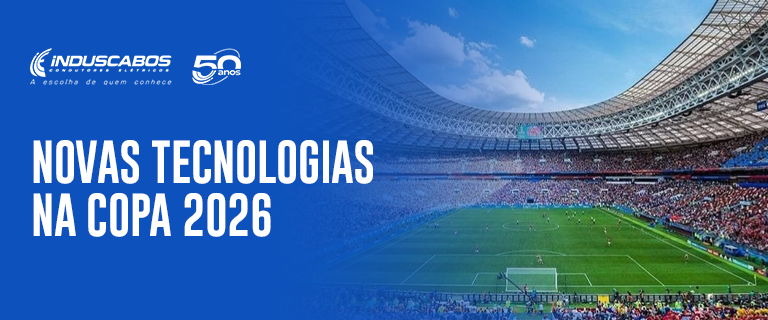
The 2026 FIFA World Cup was marked not only by the largest number of national teams and matches in the history of the tournament, but also by a strong commitment to innovation, energy efficiency and sustainability. The stadiums that hosted the matches underwent modernizations that go far beyond the fan experience: they represent a new generation of intelligent, connected and energy-efficient buildings.
Behind this transformation lies a fundamental element for the operation of the entire infrastructure: a robust, safe and reliable electrical network. From powering lighting systems and automation equipment to renewable energy generation and electric vehicle chargers, electrical cables play an essential role in ensuring performance, safety and operational continuity.
In this context, companies specializing in the supply of electrical cables for major construction projects, such as Induscabos, become strategic partners in highly complex infrastructure projects.
Solar energy integrated into stadiums
The pursuit of energy efficiency led several World Cup stadiums to invest in their own energy generation through photovoltaic systems. Some stadiums in the United States have more than 4,000 solar panels installed throughout their grounds to meet the required electricity demand. Some also have wind turbines and green energy systems integrated into their structures.
The expansion of photovoltaic generation requires an electrical infrastructure prepared to operate safely from the inverters to the distribution boards. In this type of application, high-quality electrical cables are essential to ensure energy efficiency, reliability and a long service life for the system.
LED lighting: greater efficiency and better performance
Another highlight of stadium modernization is the replacement of older lighting systems with 100% LED technology.
In addition to significantly reducing energy consumption, LED lighting offers:
- Longer equipment service life;
- Less need for maintenance;
- Excellent lighting quality for 4K and 8K broadcasts;
- Better performance at sporting and entertainment events.
All this efficiency depends on a properly designed electrical infrastructure. Low-voltage cables are responsible for safely, steadily and reliably powering lighting systems, contributing to the continuous performance of the installations.
Smart Stadiums: the new generation of intelligent arenas
The 2026 World Cup also accelerated the Smart Stadium concept, in which virtually all arena systems are monitored and controlled in real time.
The technologies present include:
- Thousands of IoT sensors;
- Building automation;
- Intelligent monitoring;
- Automated climate control;
- Energy management;
- Sports equipment management;
- Advanced security systems.
All this connectivity depends on an electrical infrastructure capable of supporting critical equipment operating simultaneously, ensuring availability and operational safety.
Intelligent energy management
Modern stadiums use platforms capable of continuously monitoring energy consumption. These systems allow:
- Automatic equipment shutdown;
- Reduction of energy waste;
- Demand control;
- Predictive maintenance;
- Automatic redistribution of loads according to stadium occupancy.
This intelligence is only possible when the entire electrical infrastructure is built using reliable components prepared to operate continuously, even under high load demands.
LEED certification and sustainable construction
One of the major distinguishing features of the 2026 World Cup is its commitment to sustainable buildings.
Currently, 13 of the 16 stadiums have LEED certification, an internationally recognized certification awarded to buildings that meet sustainability criteria such as:
- Energy efficiency;
- Water management;
- Indoor environmental quality;
- Selection of materials;
- Reduction of waste generation.
Certified projects value solutions that increase operational efficiency throughout the building’s entire service life, making the electrical infrastructure one of the pillars of this process.
Intelligent water reuse
Sustainability is also present in water resource management. Several stadiums have systems for:
- Rainwater harvesting;
- Automated irrigation;
- Reuse in restrooms;
- Intelligent consumption monitoring.
Mercedes-Benz Stadium is one of the world’s leading examples of the integration of these sustainable solutions.
Less construction, more modernization
Unlike previous editions of the World Cup, the 2026 edition prioritized the modernization of existing infrastructure.
No stadium was built exclusively for the tournament. Investments were directed toward:
- Retrofitting installations;
- Technological upgrades;
- Energy efficiency;
- Reduction of carbon emissions;
- Lower waste generation.
This model demonstrates that major construction projects can evolve more sustainably by taking advantage of existing structures and incorporating new technologies.
Infrastructure prepared for Artificial Intelligence
The stadiums were also prepared to support applications based on Artificial Intelligence. These include:
- Intelligent cameras;
- Image recognition;
- Connected sensors;
- High-capacity networks;
- Advanced refereeing systems, such as VAR, semi-automated offside technology and sensor-equipped balls.
All this technology depends on a highly available electrical infrastructure capable of ensuring a continuous power supply for critical systems during large-scale events.
The invisible infrastructure that makes all the difference
Although it often goes unnoticed by spectators, electrical infrastructure is one of the most important elements for the success of projects such as the 2026 World Cup.
Investing in high-quality electrical infrastructure means investing in the safety, energy efficiency and longevity of any major development.
Count on Induscabos for highly complex projects and the restructuring of energy works to modernize all your projects. Contact us. Request a quote