When discussing electrical installations, a very common question is: what is the difference between a rigid cable and a flexible cable?
At first glance, both perform the same function: conducting electrical energy safely. However, the way they are constructed directly influences installation, handling, and the applications best suited to each type of cable.
In this article, you will understand the main differences between them and discover why flexible cables are currently the most widely used in electrical installations.
What is the difference between a rigid cable and a flexible cable?
The main difference lies in the construction of the conductor.
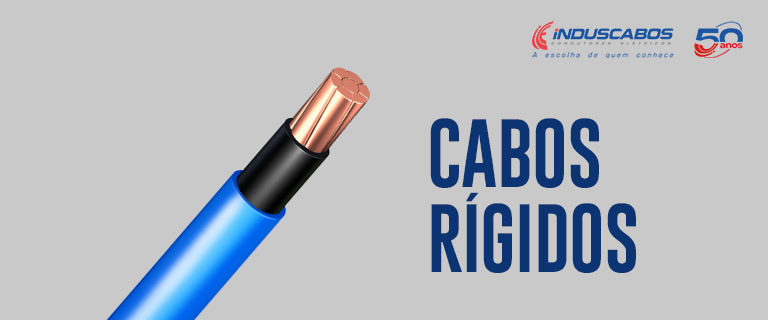
A rigid cable is made with only a few copper wires. In older installations, it was also common to find conductors made from a single solid wire, popularly known as rigid wires.
A flexible cable, on the other hand, consists of several fine copper wires stranded together. This construction provides greater flexibility without compromising electrical conduction.
In summary:
- Rigid cable: has only a few wires or a single solid conductor.
- Flexible cable: has several fine wires forming a single conductor.
This characteristic makes a significant difference during installation.
Which one is easier to install?
In practice, flexible cable is much easier to install.
Its structure allows it to bend easily, simplifying passage through electrical conduits, raceways, trunking, and electrical panels. As a result, it reduces installation effort and makes the electrician’s work faster.
Rigid cable has less flexibility and tends to retain its original shape. In sections with many bends, installation requires more effort and can make the process more difficult.
For this reason, flexible cable has become the standard in most modern installations.
Where is each type of cable used?
Today, flexible cables are widely used in several applications, including:
- Residential electrical installations.
- Commercial installations.
- Industrial environments.
- Electrical panels.
- Machinery and equipment.
- Systems that require easier installation.
Rigid cables, on the other hand, are less common today and are generally used in very specific applications, especially where the conductor remains practically stationary throughout its service life.
Although applications for this type of conductor still exist, its use is far less common than that of flexible cables.
Does flexible cable carry more current?
This is another frequently asked question.
The answer is no.
Many people believe that because flexible cable contains several fine wires, it can carry more electrical current. In reality, this is not the case.
The current-carrying capacity of a cable is determined mainly by its nominal cross-sectional area, as well as installation conditions, ambient temperature, insulation type, and other criteria established by technical standards.
In other words, a rigid cable and a flexible cable with the same nominal cross-sectional area, manufactured in accordance with the applicable standards, have equivalent current-carrying capacity when installed under the same conditions.
Flexibility makes installation easier, but it does not increase the electrical capacity of the cable.
How do you choose between rigid and flexible cable?
In most modern electrical installations, flexible cable is the most widely used option because of its practicality during installation.
Its ability to pass through conduits, bend easily, and organize electrical panels reduces assembly time and contributes to a more efficient finish.
Rigid cable may still be suitable for specific applications where movement or flexibility is not required, provided its use complies with the electrical design and applicable standards.
The correct choice should always consider the installation environment, the electrical design, and the technical requirements of the application.
Count on Induscabos quality
For 50 years, Induscabos has been developing electrical wire and cable solutions that combine quality, reliability, and compliance with technical standards.
Our product line serves applications ranging from residential installations to major industrial projects, delivering safety, performance, and technology to a wide variety of market segments.
When the specification is correct, the installation becomes safer, more efficient, and more durable.
Induscabos 50 years. Connecting the present to the future.
Choose the right cable for every application
Induscabos offers electrical wires and cables developed for different types of installation, combining quality, safety, and performance.
Our team is prepared to support your company in choosing the most suitable solution, taking into account nominal cross-sectional area, conductor type, installation environment, and project requirements.
Count on the experience of a company that has been connecting projects, people, and results for 50 years.
Request a quote