Medium-voltage cables play a strategic role in electrical systems that require operational continuity, safety and adequate power distribution capacity. They are used in sections where electricity must be carried under controlled technical conditions between generation, transformation and consumption points, particularly when a project involves longer distances, more demanding environments or dedicated installation infrastructure.
In practice, these cables are found at various stages of electricity distribution and help connect substations, distribution networks and industrial facilities. Their specification should therefore be viewed not merely as a product choice, but as part of the overall performance of the electrical system, with a direct impact on operational reliability and installation safety.
For resellers, distributors, engineers, technical buyers and system integrators, understanding the characteristics of medium-voltage power cables is essential to avoiding incompatibilities between the cable, the installation method and actual service conditions. In industrial and infrastructure projects, this assessment is often decisive in reducing risks and keeping the system within its expected operating parameters.
What are medium-voltage cables and what is their role in an electrical system?
The term medium voltage refers to voltage levels between low and high voltage. In Brazil, ABNT NBR 14039 sets requirements for medium-voltage electrical installations from 1.0 kV to 36.2 kV. Cables in this segment, in turn, are specified by their rated insulation voltages, such as 3.6/6 kV to 20/35 kV, according to their construction and the applicable standards. It is therefore essential to verify the cable’s rated voltage and its compatibility with the system in which it will be installed.
These cables carry electricity through distribution circuits that require greater electrical and mechanical robustness than low-voltage cables. They are used in feeders, interconnections between substations and larger loads, as well as in underground power networks and industrial facilities with significant demand.
In a properly designed system, a medium-voltage cable operates alongside transformers, circuit breakers and other protection and switching equipment. This integration matters because the cable does not operate in isolation: it is part of a chain of components that must work together to ensure performance, protection selectivity and safety.
When the project properly accounts for the application of medium-voltage cables, the result is generally more reliable distribution, better suitability for the surrounding environment and a lower likelihood of failures caused by undersizing or incompatible installation methods.
How medium-voltage power cables are constructed
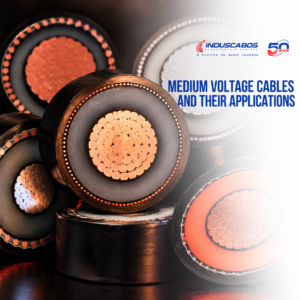
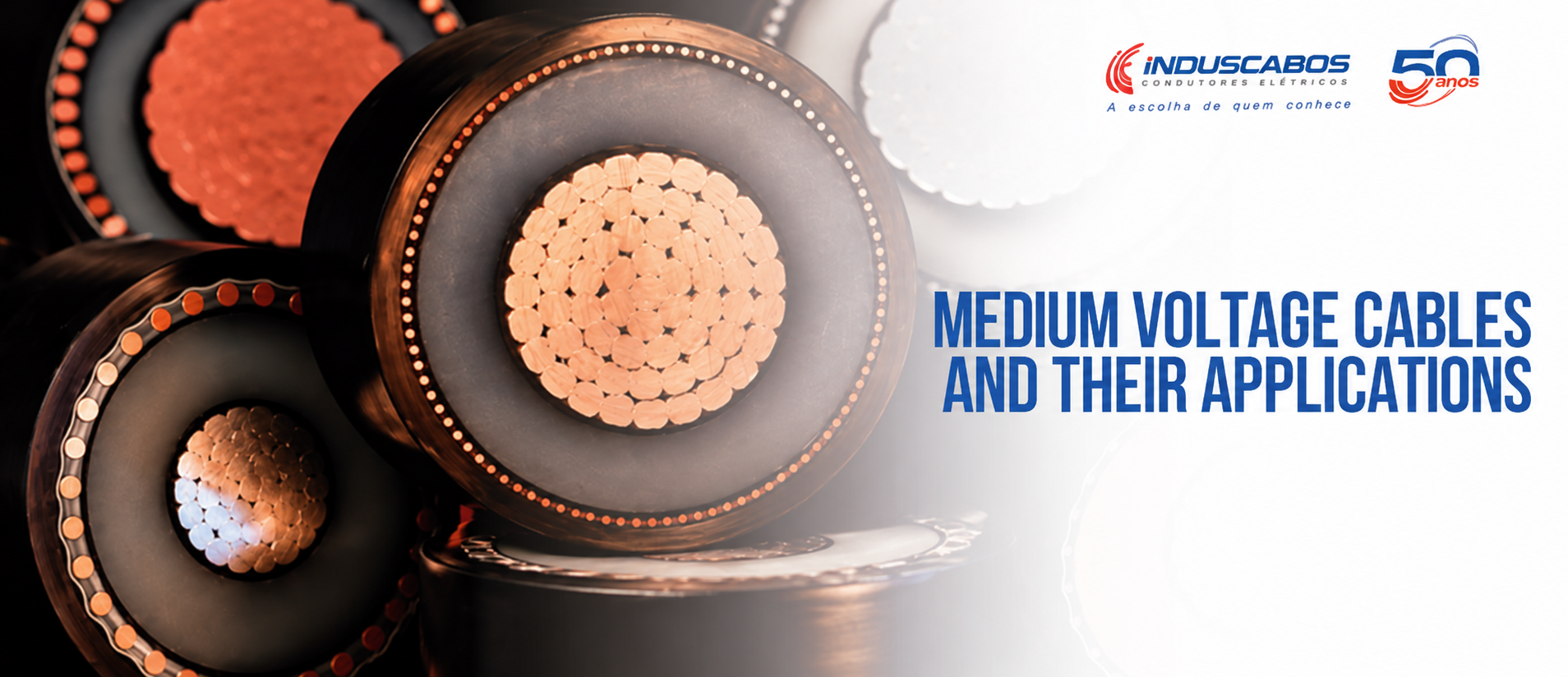
Medium-voltage power cables are designed to withstand electrical, thermal and mechanical stresses in different installation scenarios. Although designs vary from project to project, their construction generally includes components such as the conductor, insulation, screens and outer sheath.
Conductor
The conductor is the component that carries electric current. In medium-voltage projects, copper or aluminum conductors may be selected according to engineering criteria, total system cost, required current-carrying capacity and installation characteristics. Material choice affects weight, flexibility, electrical resistance and compatibility with accessories and terminations.
Insulation
Insulation is one of the cable’s most important components because it electrically separates the conductor from the other layers and the outside environment. In medium-voltage cables, materials such as EPR and XLPE are widely used for their electrical and thermal performance, always subject to project specifications and compatibility with the installation environment.
Screens
Cable screens perform different functions in medium-voltage cable construction. Semiconductive layers help make the electric field more uniform at the conductor and insulation interfaces. Where a metallic screen is included, it must be sized and grounded in accordance with the design, taking fault currents and safety requirements into account. Together, these layers contribute to system reliability.
Outer sheath
The outer sheath provides an additional layer of protection against mechanical agents and environmental conditions. In underground networks, industrial areas and sections subject to greater exposure, this layer can be an important factor in preserving cable integrity over time.
Applications of medium-voltage cables across different sectors
Medium-voltage cables have a wide range of applications, reflecting the need to carry electricity safely in diverse environments. Each sector has specific installation, maintenance and performance requirements, reinforcing the importance of correct specification.
In industrial facilities, these cables are used for main power feeds, internal interconnections and systems requiring process continuity. In shopping centers, they can serve distribution areas with substantial loads and a need for organized electrical infrastructure. In mining, cable robustness and suitability for the environment are critical factors in withstanding severe operating conditions.
In urban infrastructure, medium-voltage cables are used in underground networks, interconnections between distribution points and solutions that prioritize visual organization, protection from external interference and efficient use of space. In renewable energy developments, they may also be used to connect generation facilities to the grid, always according to the electrical arrangement defined for the project.
- Industries with continuous loads and a need for operational reliability
- Shopping centers requiring organized and safe power distribution
- Mining operations facing more demanding environmental and mechanical conditions
- Urban infrastructure favoring underground electrical networks
- Renewable energy projects connecting generation and distribution points
EPR and XLPE insulation: why these materials matter
Insulation type is among the most closely examined aspects when specifying medium-voltage cables. EPR and XLPE are commonly used in this segment because they offer properties suitable for applications where the cable must withstand electrical and thermal stresses consistently.
The choice between EPR and XLPE should not be based solely on commercial preference. It depends on the design, installation conditions, operating duty and environmental requirements. In some cases, thermal behavior, desired flexibility or the installation method may influence the technical decision.
From a practical standpoint, suitable insulation contributes to system reliability and the cable’s expected service life. When the insulation is compatible with the application, the system generally performs better under normal operating conditions and is less vulnerable to variations that could compromise the cable assembly’s electrical integrity.
Therefore, when assessing industrial medium-voltage cables or cables intended for underground networks, it is worth considering not only the insulation material but also how the insulation, screens, outer sheath and installation accessories work together.
Specification criteria that should guide cable selection
Medium-voltage power cable specifications must consider the project as a whole rather than a single parameter. Rated voltage is one of the first criteria to assess, since the cable must be compatible with the system voltage level and the expected operating conditions.
Another essential criterion is conductor cross-sectional area. It affects current-carrying capacity and must be determined based on load, operating duty, permissible losses and the installation method. An undersized cable can overheat and jeopardize system reliability, while an oversized cable may increase costs without a proportional technical benefit.
Environmental conditions must also be evaluated. Temperature, humidity, chemical exposure, mechanical stresses and installation in conduits, cable trays, ducts or direct burial can affect cable behavior and call for specific solutions. In underground power networks, for example, analyzing the soil and laying method can be just as important as selecting the insulation material.
In addition, the installation method affects final performance. Cables installed over long runs, around bends, in confined spaces or in industrial environments with vibration and mechanical interference must be selected carefully to avoid undue stress during installation and operation.
- Rated voltage compatible with the system
- Conductor cross-sectional area suited to current and operating duty
- Environmental and mechanical conditions at the site
- Installation method specified in the design
- Compatibility with accessories, terminations and protection equipment
Technical standards, safety and project reliability
In medium-voltage cable projects, technical standards must be considered according to their respective scopes. ABNT NBR 6251 sets construction requirements for power cables with extruded insulation; ABNT NBR 7286 addresses performance requirements for cables insulated with EPR, HEPR or EPR 105; and ABNT NBR 7287 addresses XLPE-insulated cables. ABNT NBR 14039, in turn, provides requirements for medium-voltage electrical installations, according to the application and project needs.
Compliance with relevant standards helps guide manufacturing, installation and use criteria, reducing ambiguity in specifications and making it easier to ensure compatibility among cables, accessories and associated equipment. For technical buyers and the responsible engineer, this means more predictable procurement and safer implementation.
It is also important to remember that safety and reliability depend on more than the cable itself. They result from the combination of sound design, correct installation, planned maintenance and consistent selection of system components. In industrial applications, this is especially important because unplanned shutdowns can affect productivity, costs and operational continuity.
Conclusion: why choosing the right cable makes a difference
Medium-voltage cables are central components in electrical power distribution and a broad range of industrial and infrastructure applications. Their role goes beyond transmitting electricity: they must integrate into the project safely, perform reliably and suit the installation environment.
By considering construction, insulation, screens, outer sheath, rated voltage, conductor cross-sectional area and installation conditions, the responsible professional reduces risks and improves system reliability. This assessment becomes even more important in industrial facilities, mining, shopping centers, underground networks and renewable energy projects.
For Induscabos, medium-voltage solutions are closely linked to serving the B2B market through correct specification and suitable application. This means supporting projects that require technical rigor and alignment between cable performance and the realities of the electrical system.